TimescaleDB v2.27.1 is a stability and security patch released one week after 2.27.0. It closes three access-control gaps in the jobs and policy subsystems, corrects two planner cases where ColumnarIndexScan was incorrectly selected for GROUPING SETS / ROLLUP / CUBE and grouping-by-expression queries, and ships upgrade-compatibility scripts for installations with composite bloom filter metadata. TimescaleDB 2.27.1 was released on May 19, 2026, and was made available on Tiger Cloud right after release.
Three independent fixes in the jobs and policy subsystems close cases where users could observe or act on objects they did not own.
Hypertable ownership enforced before recompression: Recompression operations now verify ownership before proceeding. Previously, users could trigger recompression on hypertables they did not own.
job_errors view restricted to owners: Failed-job visibility is now scoped — only owners see failure rows for their own jobs. Previously, non-owners could read failure information they should not have had access to.
policy_reorder_remove ownership check added: The policy-management operation now enforces ownership before allowing changes, closing a path that previously leaked policy-existence information to non-owners.
columnstore planner corrections
Skip ColumnarIndexScan for GROUPING SETS, ROLLUP, and CUBE: These aggregate forms now bypass the ColumnarIndexScan path enabled by default in 2.26, where it could otherwise select an unsuitable scan plan.
Skip ColumnarIndexScan when grouping by expression: Queries that group by an expression (rather than a bare column) now also bypass the path to avoid inefficient planning choices.
Upgrade compatibility
Orphaned compression_settings removed during catalog migration: The upgrade path now deletes stale compression_settings rows before migrating the catalog, preventing them from interfering with the migration.
Migration scripts for composite bloom filters: Ships upgrade-compatibility scripts for installations carrying composite bloom filter metadata, complementing the format change documented in 2.27.0’s backward-incompatible notes.
TimescaleDB 2.27.0 is a performance-focused release that extends bloom filter pruning into the write path so UPDATE, DELETE, and UPSERT can now skip decompressing batches that can’t match, broadens vectorized execution on the columnstore to cover more analytical query patterns, and introduces an opt-in query rewriter that transparently routes matching queries to existing continuous aggregates. TimescaleDB 2.27.0 was released on May 12, 2026, and is available on GitHub and on Tiger Cloud as of May 19, 2026.
This release extends bloom filter pruning — previously only used by SELECT — to UPDATE, DELETE, and UPSERT on compressed chunks.
Bloom filter pruning for UPDATE and DELETE: Statements with equality predicates now use bloom filters to skip decompressing batches whose compressed rows can’t possibly match. When multiple bloom filters apply, the most selective one (by column count) is tried first. Benchmark examples show up to 160x faster execution on selective workloads. EXPLAIN now reports new “Compressed batches filtered” and “Batches filtered after decompression” counters.
Bloom filter pruning for UPSERT:UPSERT queries now leverage bloom filters — including the composite bloom filters introduced in 2.26 — to skip decompressing batches when the arbiter values are guaranteed not to be present. The most selective filter is chosen automatically when multiple apply. EXPLAIN adds new statistics for visibility into pruning effectiveness (batches checked, batches pruned, batches without bloom, false positives).
More queries on the vectorized columnstore path
This release expands the set of queries that stay on the high-performance columnar execution engine instead of falling back to row-based processing.
Vectorized filters via the standard PostgreSQL function path: The columnstore engine now supports vectorized evaluation of filters inline through the standard PostgreSQL function path. This broadens the class of queries that can take the fast columnar path — including continuous aggregate refreshes — with benchmarks showing speedups from 30% up to 2x on affected workloads.
Vectorized aggregation with more WHERE filters: Vectorized aggregation now applies in cases where the WHERE clause contains filters not handled through the Vectorized Filters facility, including filters on time_bucket().
Scalar array operation pushdown: Predicates of the form col IN (…) and col = ANY(…) are now pushed down into the columnar metadata scan as OR/AND clauses, so each value can be evaluated against compressed-chunk metadata before any rows are expanded.
Continuous aggregates
Automatic query rewriting with continuous aggregates (experimental, opt-in): A new planner optimization transparently rewrites user queries to use eligible continuous aggregates when the query’s aggregation exactly matches a CAgg’s definition — so applications get pre-materialized performance without referencing the CAgg directly. This feature is experimental in 2.27 and off by default. Only real-time CAggs are eligible, and CAggs with active invalidations or pending materialization ranges are excluded. PostgreSQL 16+ only. Enable with the timescaledb.enable_cagg_rewrites GUC; timescaledb.cagg_rewrites_debug_info prints eligibility diagnostics.
Compress as part of the continuous aggregate refresh policy: The CAgg refresh policy can now compress chunks of the materialization hypertable that fall within the refresh window as part of the same job, consolidating what used to require a separate columnstore policy.
Chunk exclusion for IN / ANY on open time dimensions: Queries that filter the time dimension with IN or = ANY(...) clauses now benefit from chunk pruning — the planner derives a bounding min/max range from the values so irrelevant chunks can be excluded earlier.
Faster ORDER BY … LIMIT on more compressed data: Batch Sorted Merge — which returns ordered results from compressed chunks without fully decompressing and sorting them — now applies to chunks with no segmentby, and to chunks where the query pins every segmentby column to a constant.
Quality of life and operability
Index creation progress reporting: Hypertable index builds now populate PostgreSQL‘s built-in pg_stat_progress_create_index view, so long-running builds can be monitored the same way as on plain PostgreSQL.
Automatic segmentby for direct compress: Direct compress now analyzes buffered tuples at flush time to pick an appropriate segmentby when one isn’t explicitly configured, replacing the previous static heuristic.
ALTER TABLE … RESET on materialization hypertables: Materialization hypertables now accept ALTER TABLE … RESET (...), in line with regular hypertables.
ENABLE / DISABLE TRIGGER on hypertables: Standard PostgreSQL trigger-state commands now work directly on hypertables and propagate to every underlying chunk (including ENABLE ALWAYS, ENABLE REPLICA, and DISABLE TRIGGER USER/ALL).
Notice when compression settings change: A SQL-level notice is now emitted when compression settings change so behavior shifts are visible at run time.
A bug in bloom filter sparse indexes on compressed int2 columns could cause SELECT to miss matching rows. Upgrades are blocked for affected databases until the incorrect indexes are dropped manually.
2.27 uses a new naming convention for composite bloom filter metadata. Queries continue to work, but composite bloom filters created in 2.26 won’t be used until a lightweight, catalog-only migration script renames the legacy columns (no data recompression required).
As announced in the v2.23.0 changelog on October 29, 2025, the upcoming TimescaleDB release in June 2026 will be the last version supporting PostgreSQL 15. If you are still on PostgreSQL 15, plan an upgrade to PostgreSQL 16 or higher to maintain access to new features, bug fixes, and performance improvements.
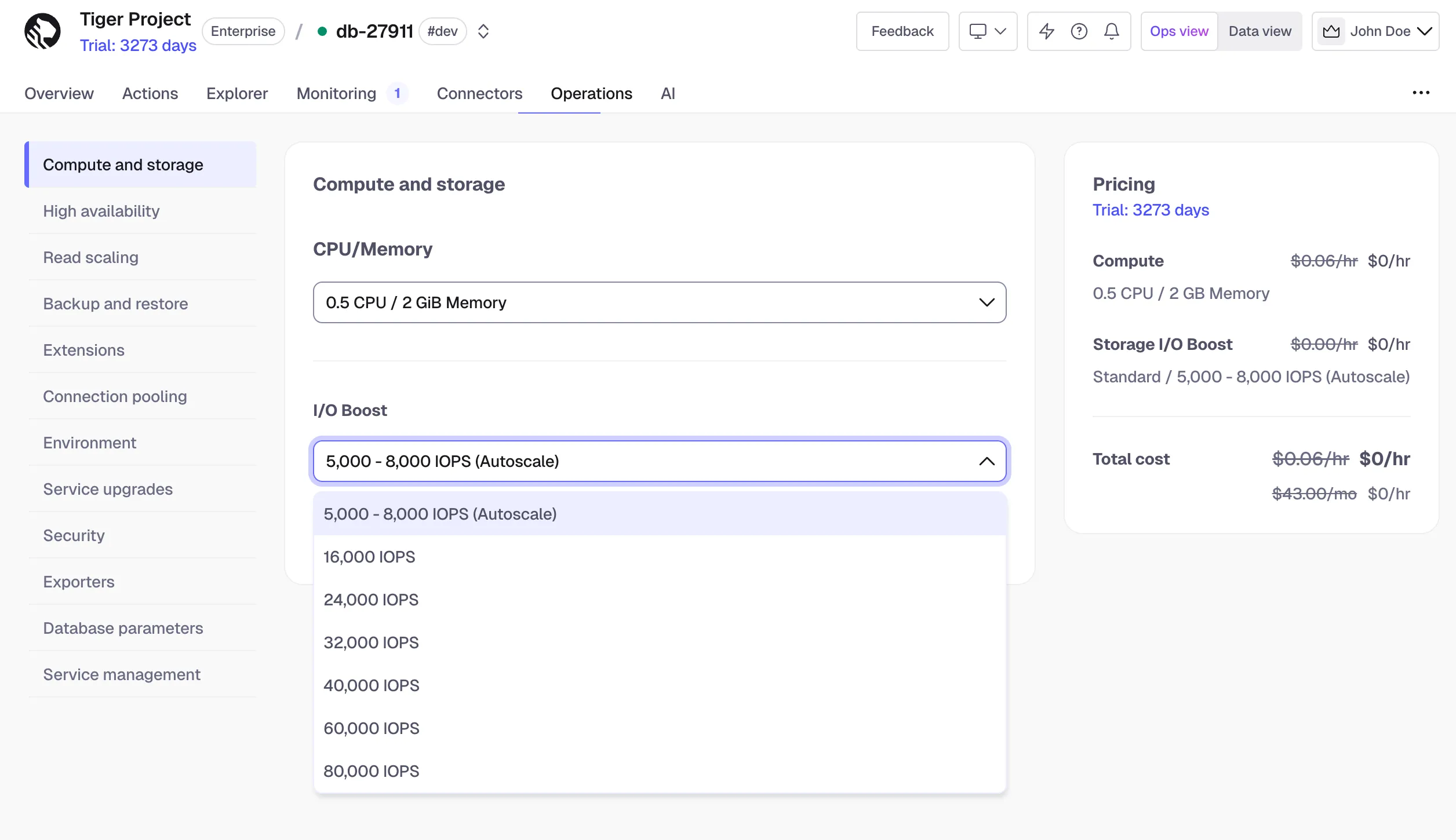
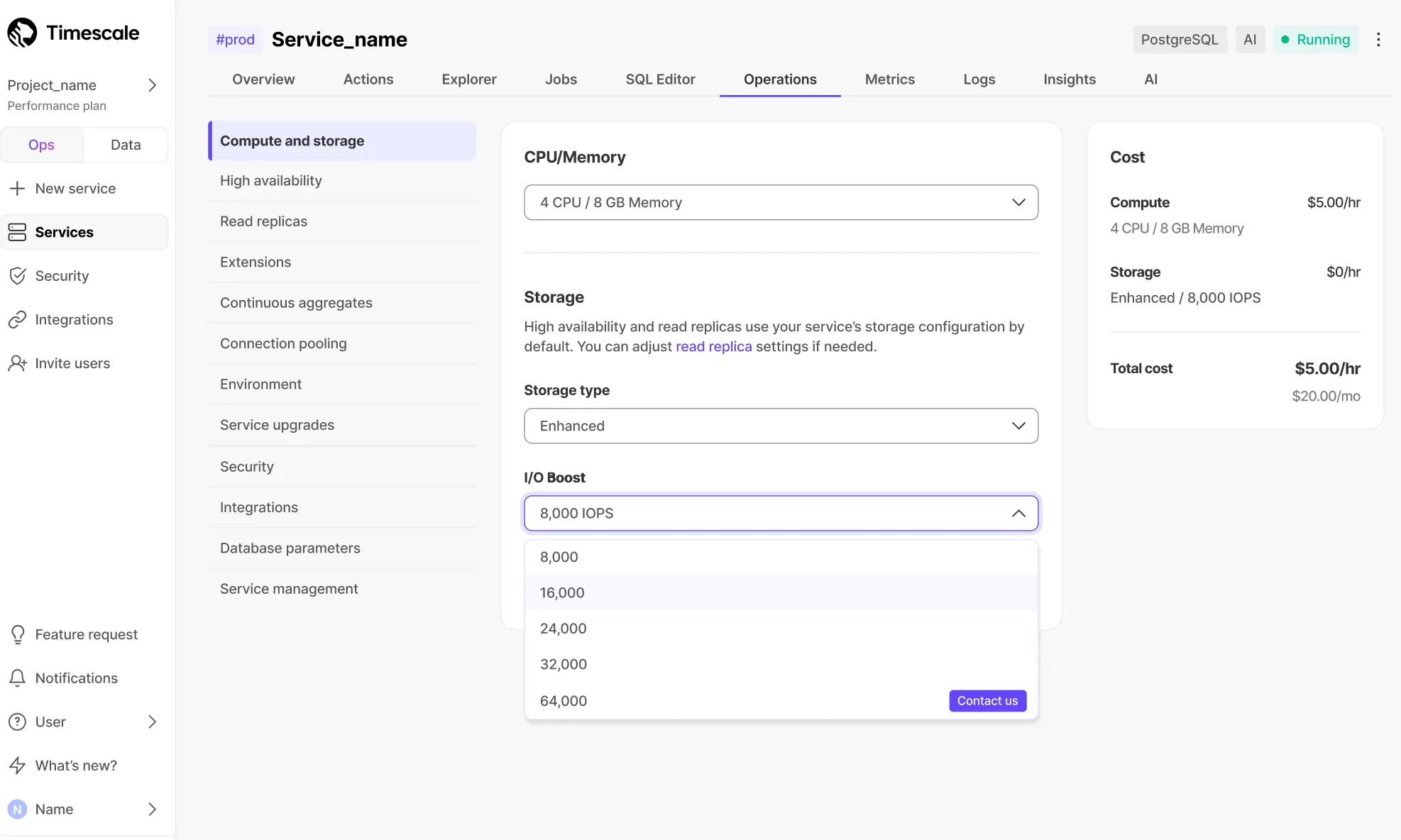
New I/O Boost options and extended storage capacity
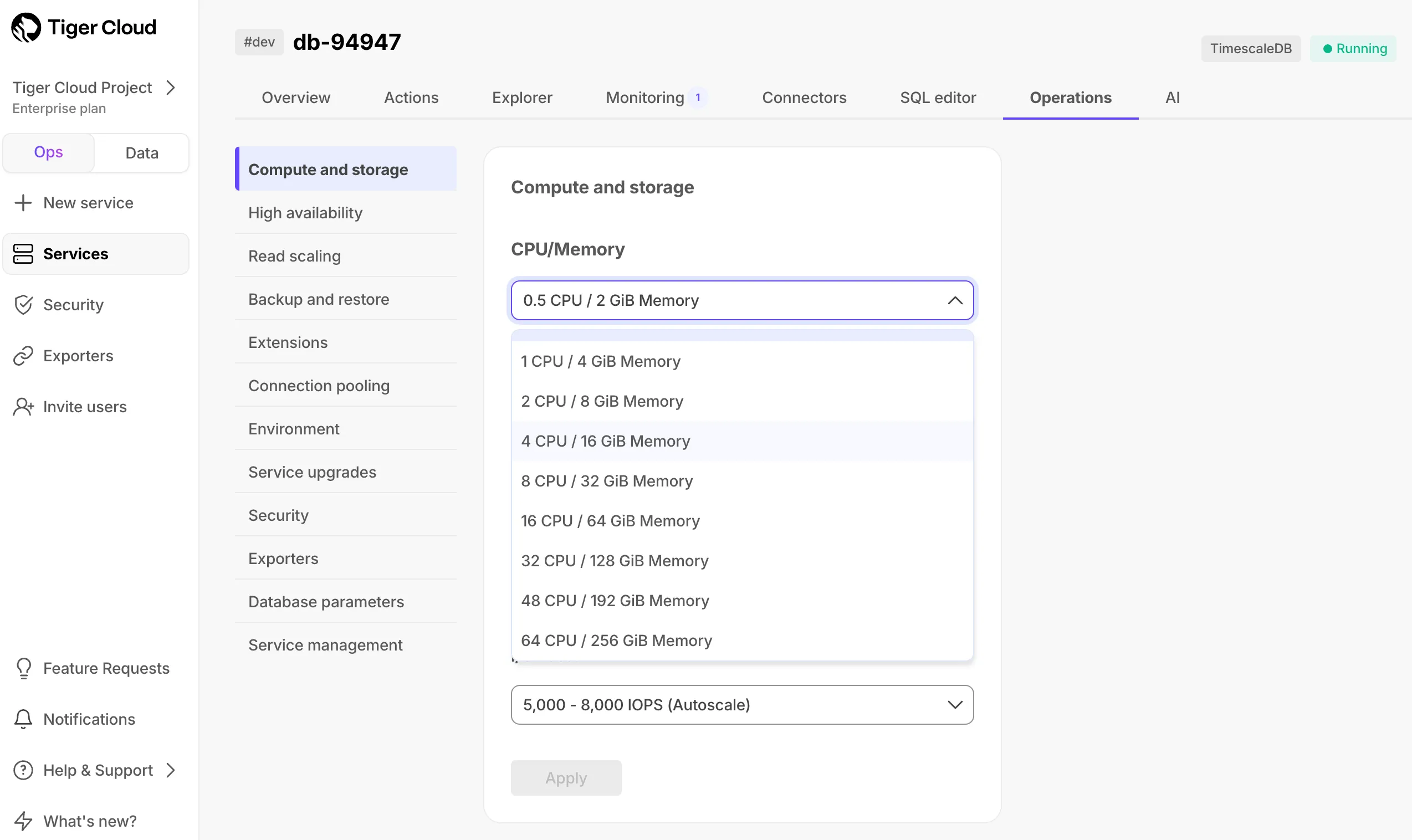
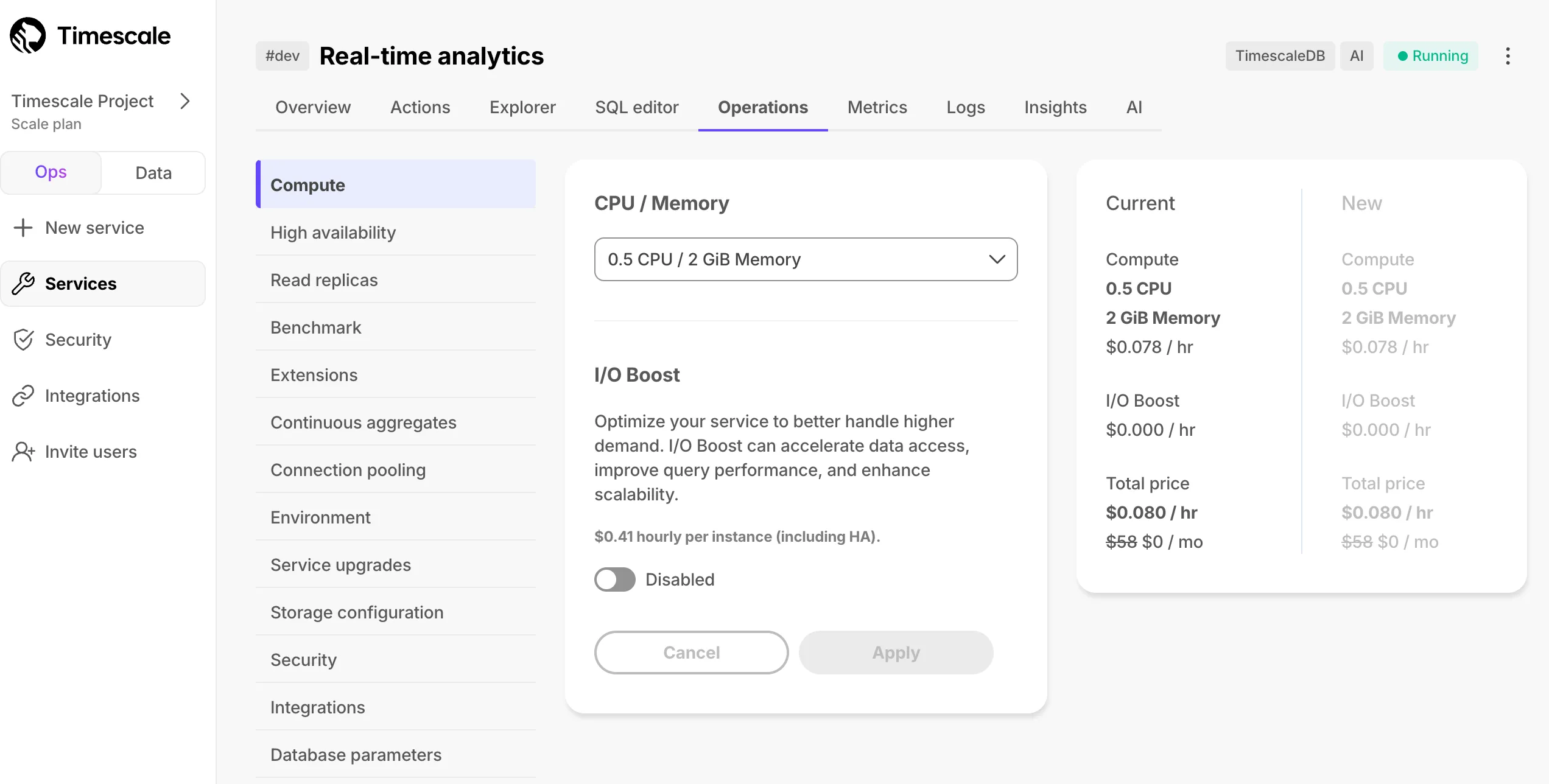
Standard high-performance storage now supports up to 80K IOPS and 4x more storage capacity (up to 64 TB) for services on the Scale and Enterprise pricing plans.
Scale: Choose between 16,000, 24,000, 32,000, and 40,000 IOPS and up to 1,500 MB/s of throughput.
Enterprise: Additional options of 60,000 and 80,000 and up to 2,000 MB/s of throughput.
IOPS changes are applied without downtime and billed $0.41 per hour per 16K IOPS, prorated to the selected option. Minimum CPU limits apply.
Support for private endpoints is now generally available on AWS and Azure
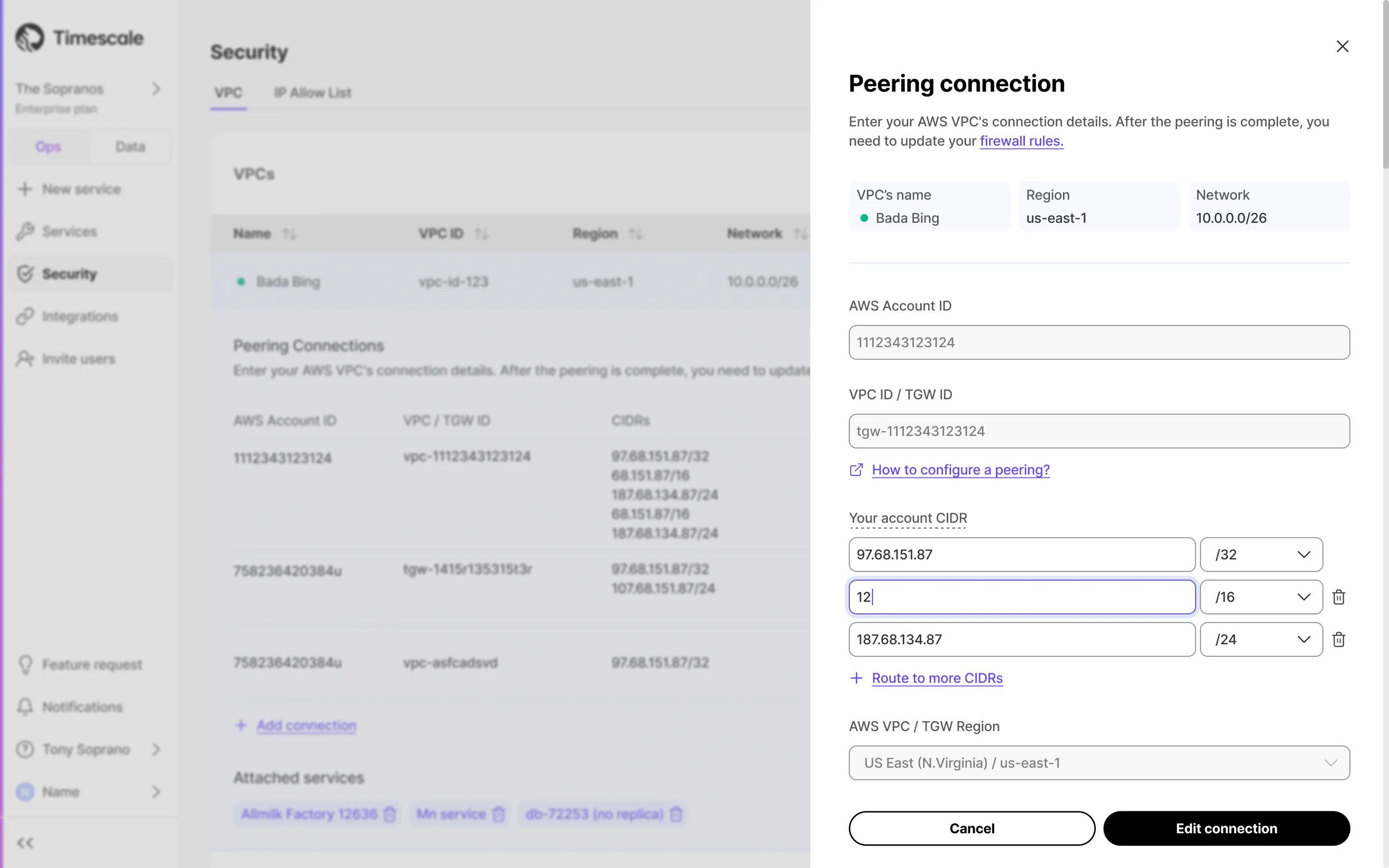
Support for private endpoints is now generally available on AWS and Azure across all Tiger Cloud supported regions. Connect your applications to Tiger Cloud over private network links to keep database traffic off the public internet and inside the trust boundary your security team already relies on.
AWS PrivateLink: Reach Tiger Cloud services from your AWS VPC over the AWS private network, with no exposure to the public internet.
Azure Private Link: Connect from your Azure VNet to Tiger Cloud over Microsoft’s private backbone with the same private-by-default model.
All supported regions: Available everywhere Tiger Cloud runs on AWS and Azure, with no regional gaps at GA.
Console-based setup: Provision and manage private endpoints directly from Tiger Console — no manual networking configuration required.
Scale and Enterprise plans: Included on the Scale and Enterprise pricing tiers.
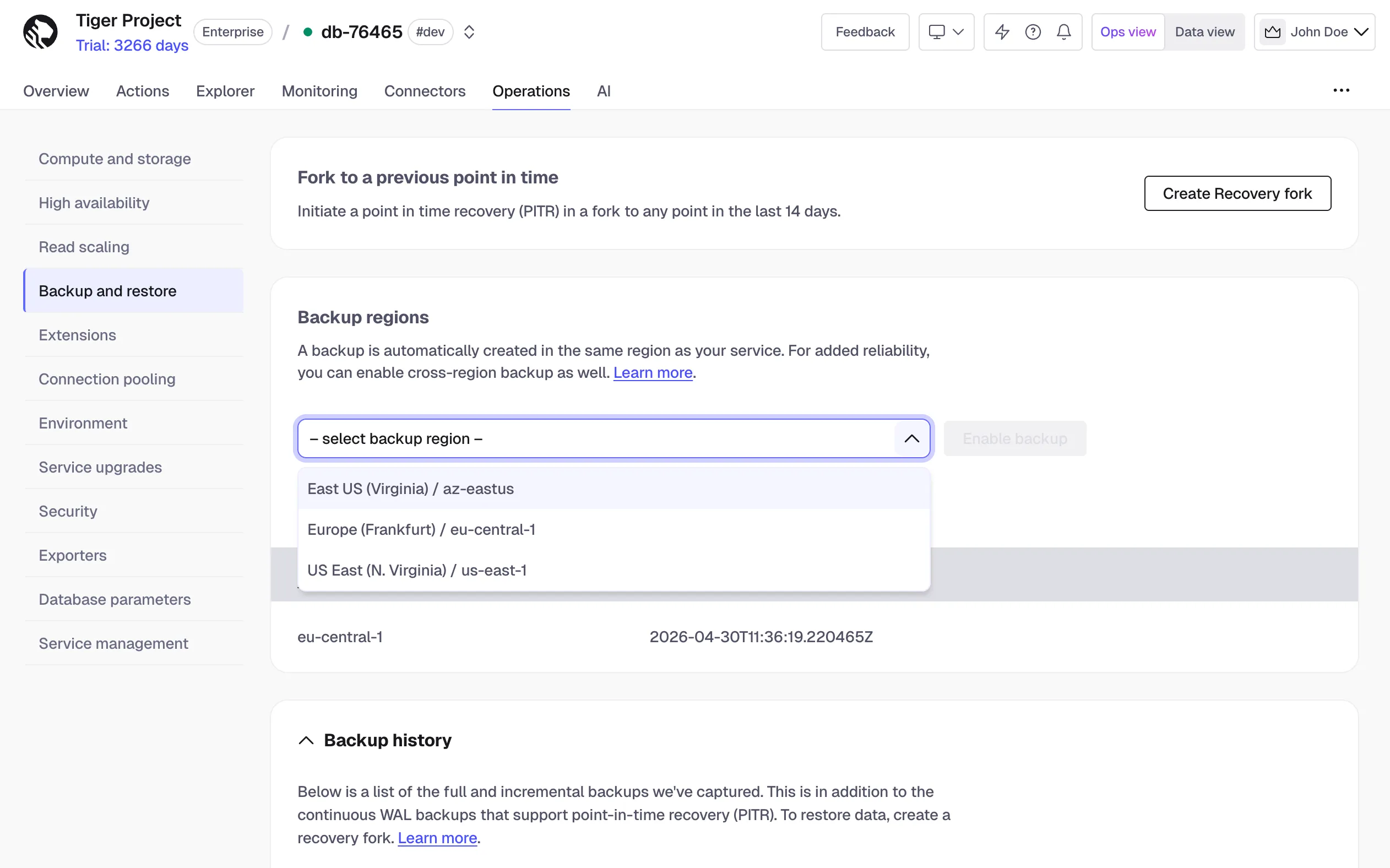
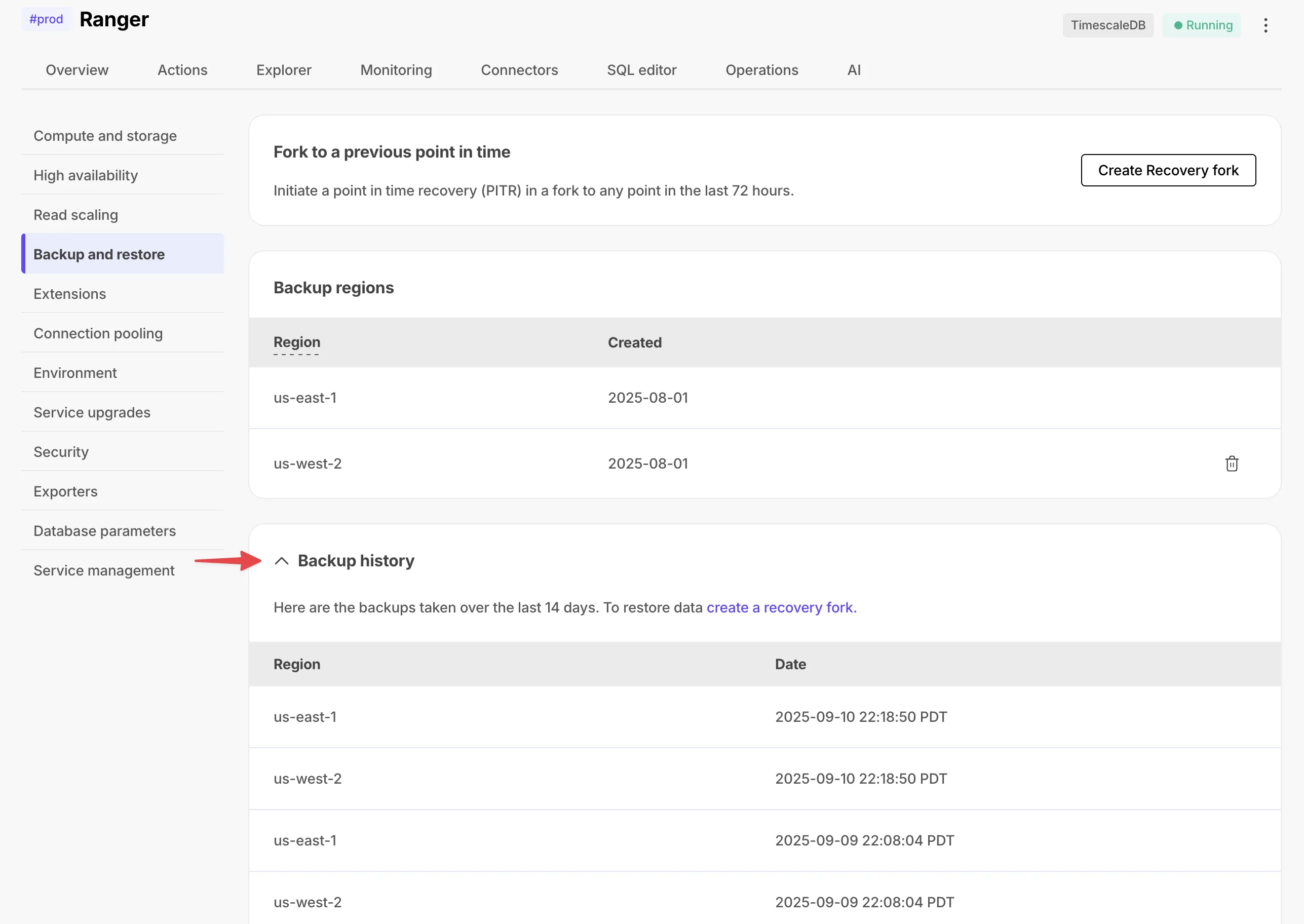
Cross-region restore is now available on Enterprise
Cross-region backup protects data by copying backups to a separate, geographically distant region. Users subscribed to the Enterprise plan can now restore from a cross-region backup using the Tiger Console, ensuring business continuity in the event of a regional outage.
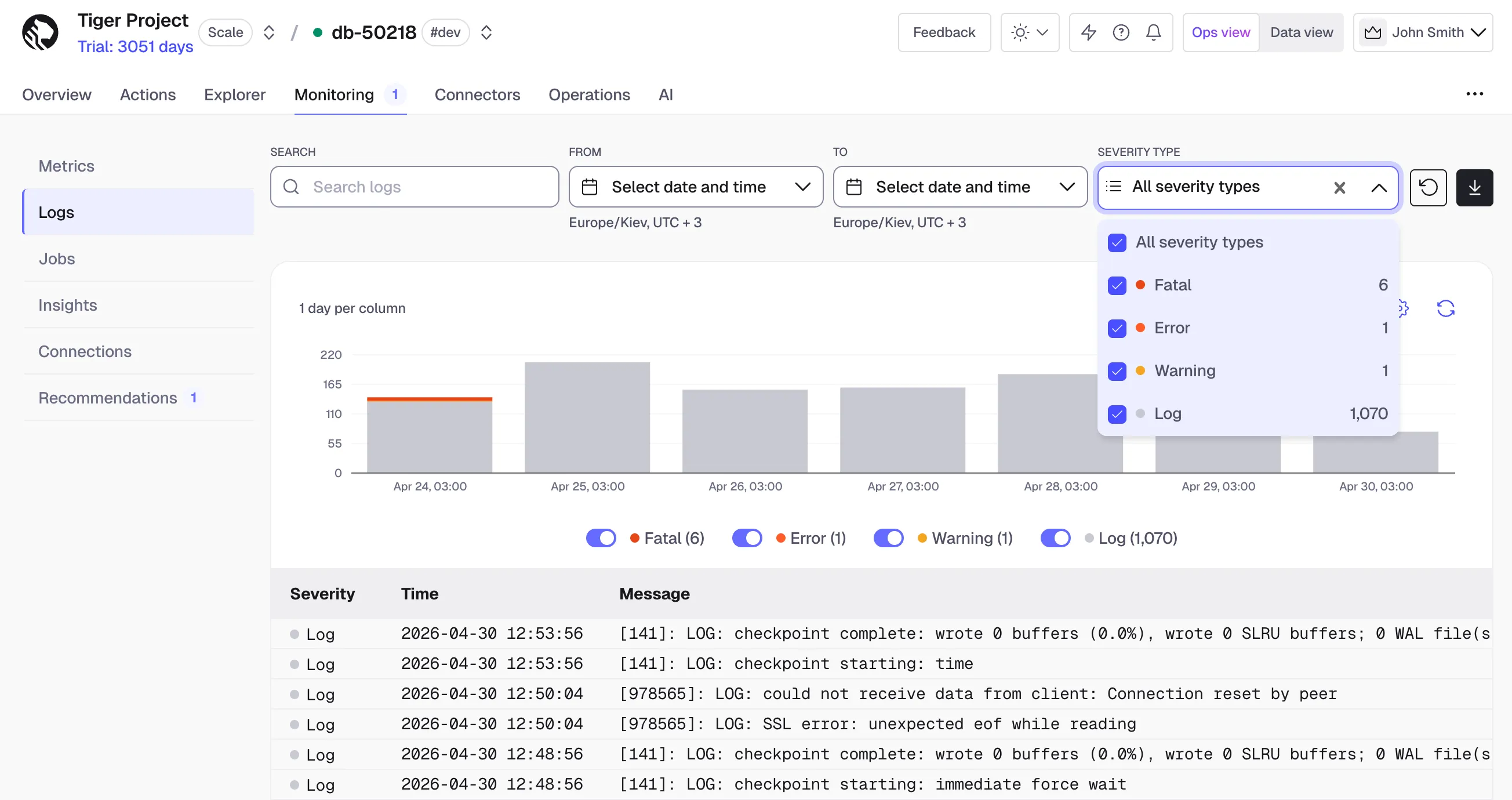
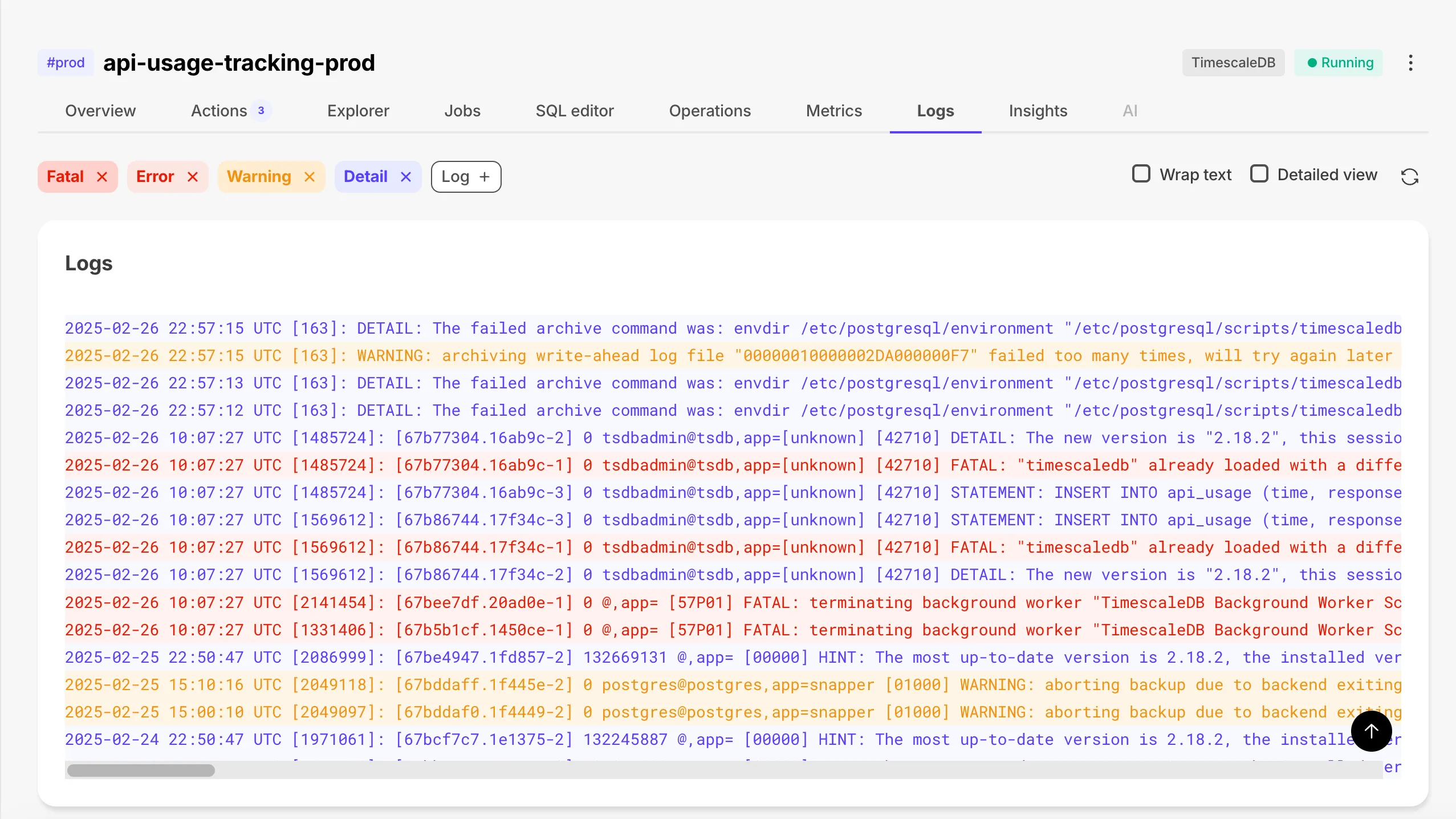
Logs page revamped with search, filters, histogram view, and more
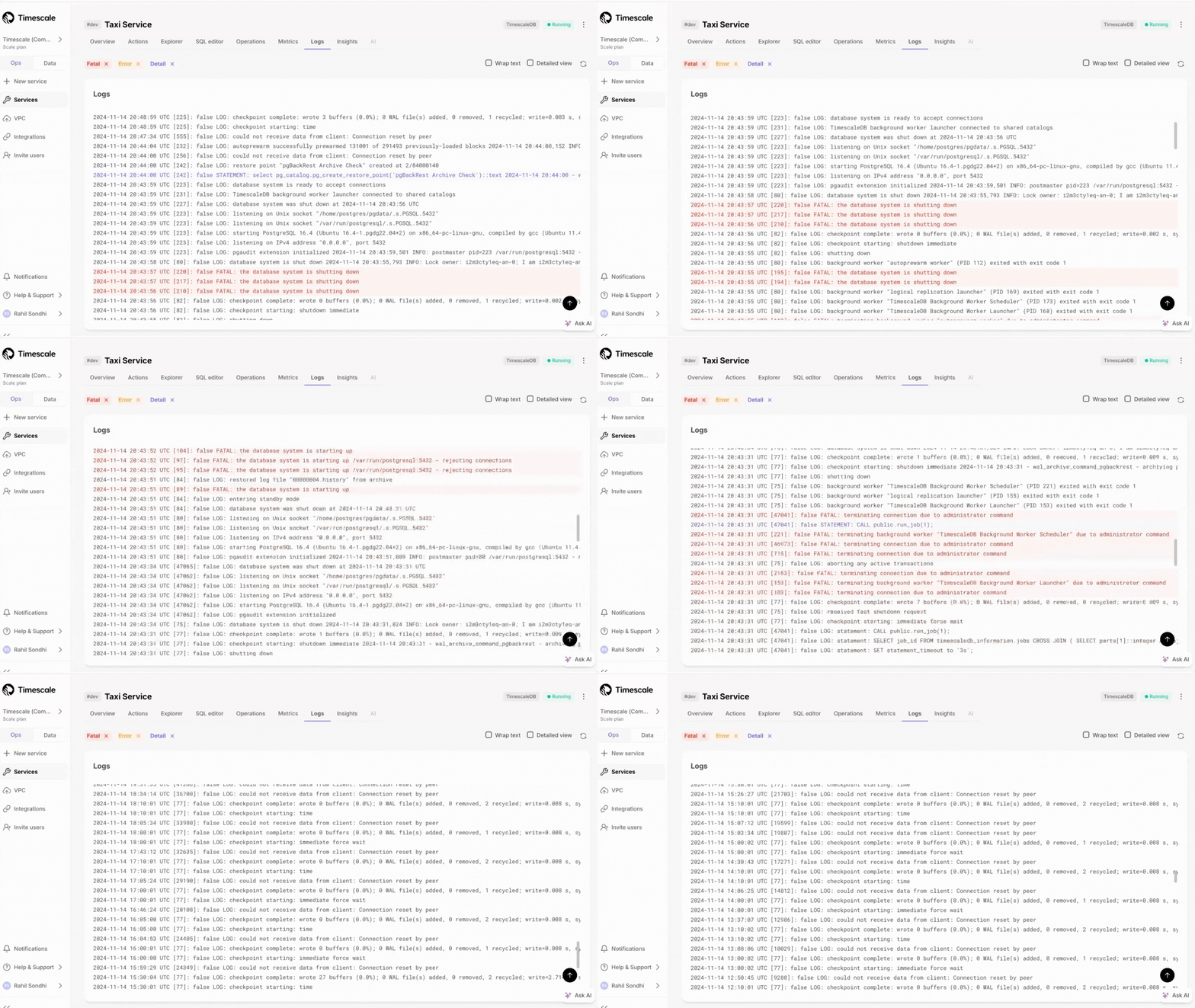
The Logs page in Tiger Console has been redesigned to make it easier to investigate and debug database issues. This release adds several new capabilities and improves the overall experience based on customer feedback.
Search: Search log output directly in Tiger Console to find specific phrases or messages
Severity filters: Filter by log severity level to focus on the entries relevant to your investigation
Histogram view: A log volume histogram shows how activity has changed over time, making it easier to correlate spikes with database or application changes
Improved time selectors: Updated date and time pickers let you scope the log view to a specific window more precisely
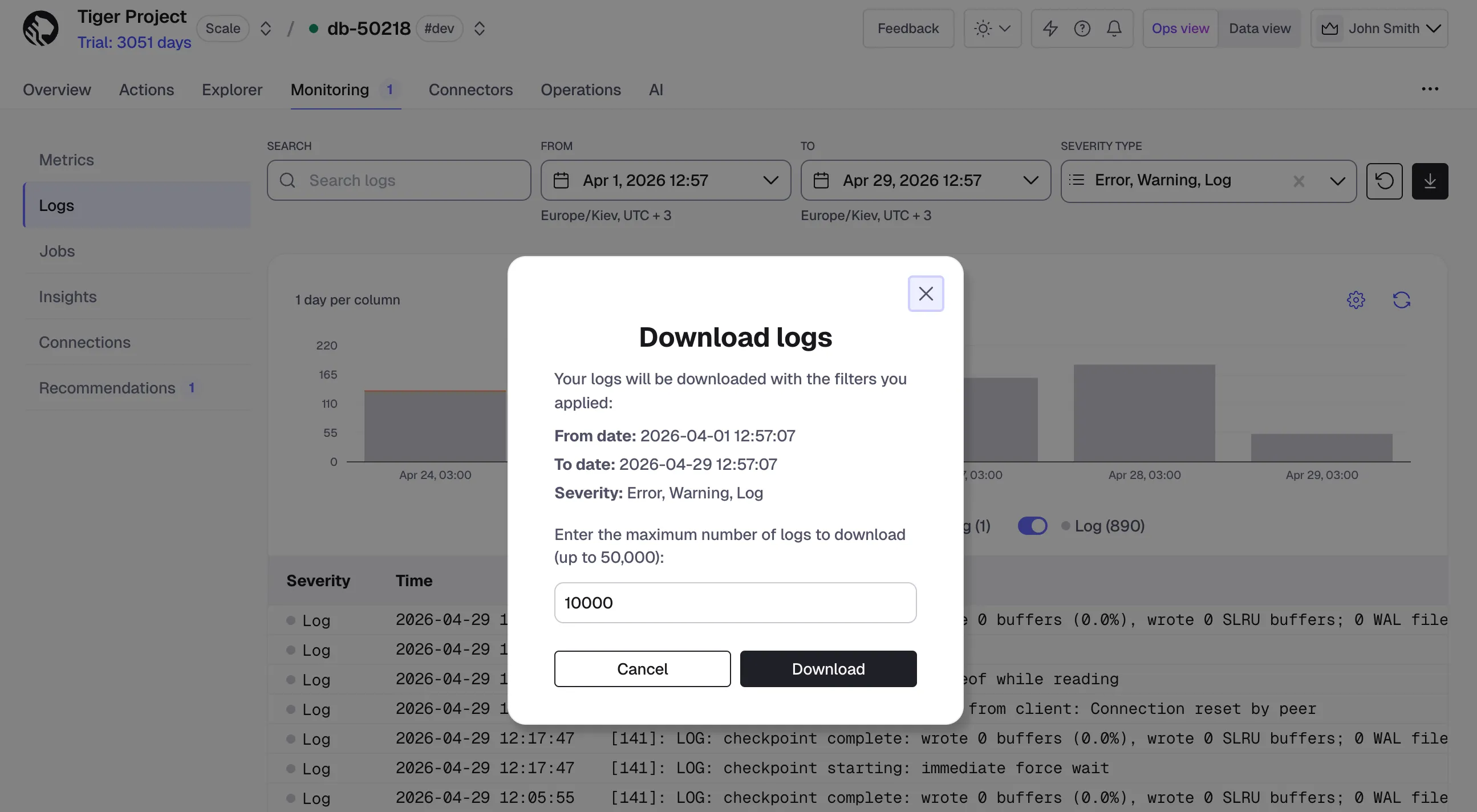
CSV export: Download logs as a CSV for analysis in external tools
Scroll improvements: Fixes glitchy scroll behavior when browsing large log volumes
Copy: Copy individual log lines directly from the UI
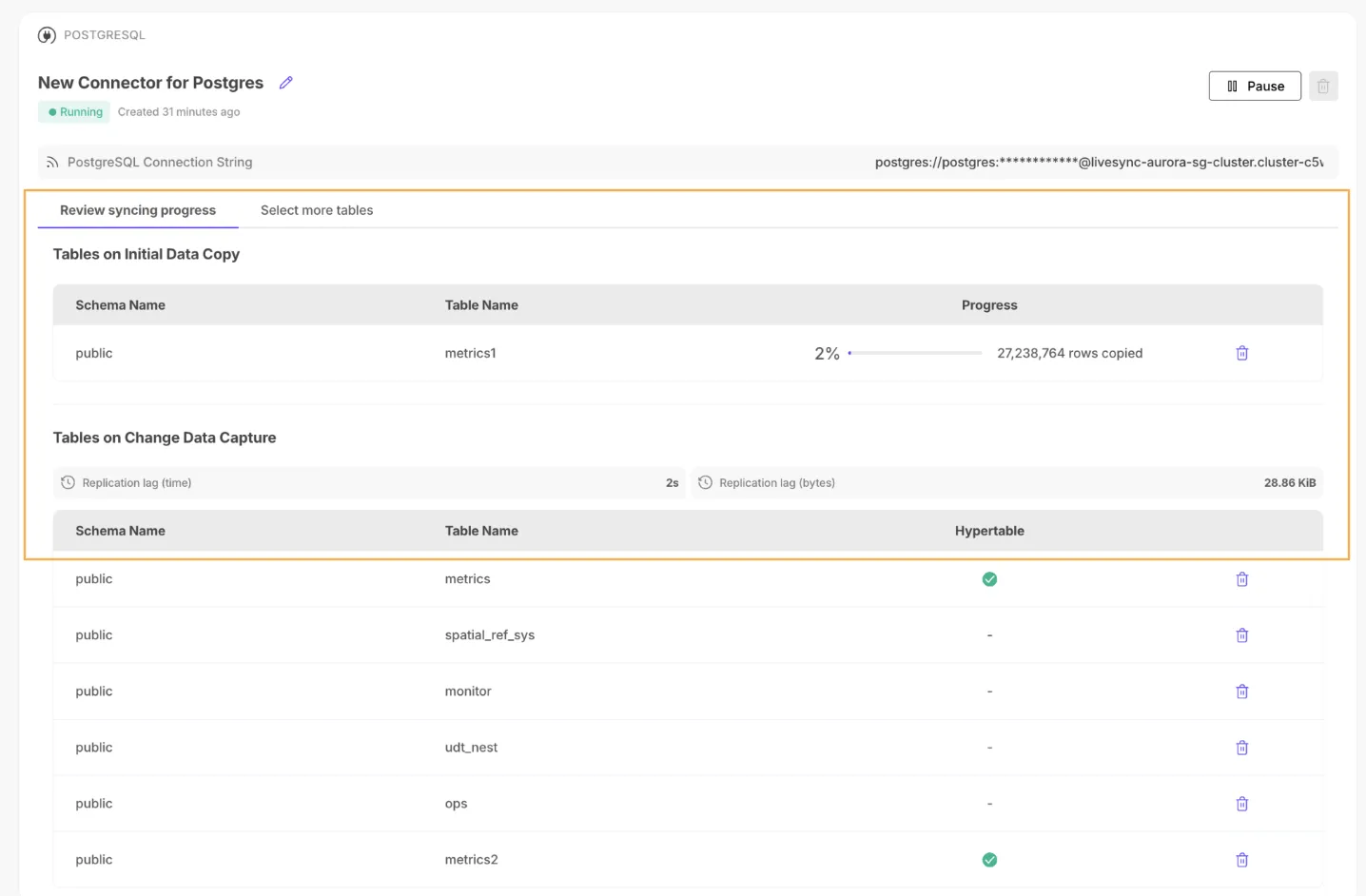
PostgreSQL Source Connector is now GA (production-ready)
PostgreSQL Source Connector is now GA (production-ready)
The PostgreSQL Source Connector is now generally available (GA), completing its migration to the Tiger Connect architecture. This improves reliability, scalability, and
consistency with other connectors.
What’s new
Aligned with Tiger Connect architecture, replacing legacy components
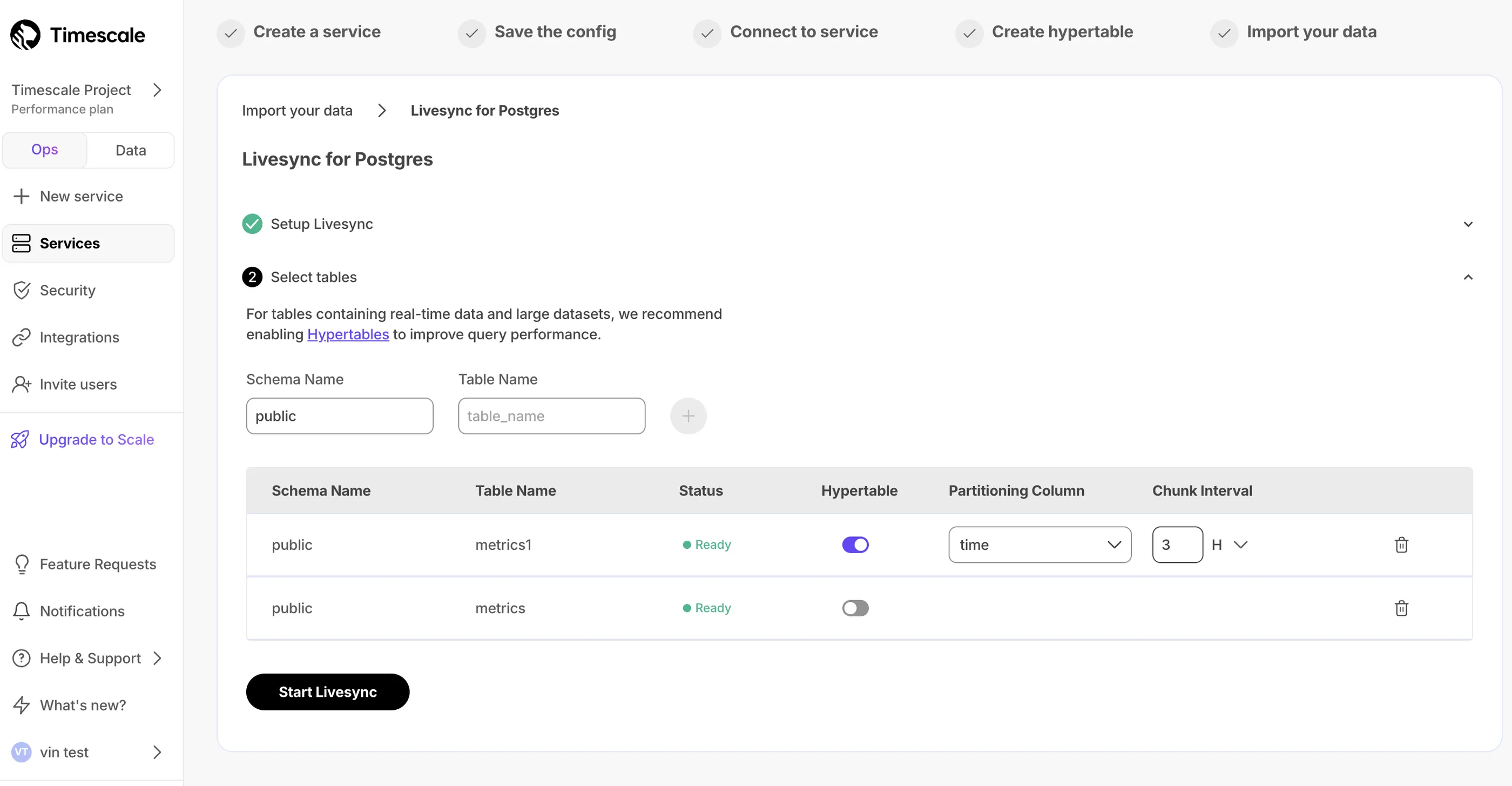
Configurable worker count for initial data copy during setup for improved performance
Flexible table selection:
Select via publication
Select tables directly
Redesigned UI with separate Overview and Settings views
SSH tunneling support for secure connections
Bulk updates for table and schema mappings
Improved hypertable configuration experience
General UX and workflow improvements
Notes: This release marks the connector as stable and ready for production use.
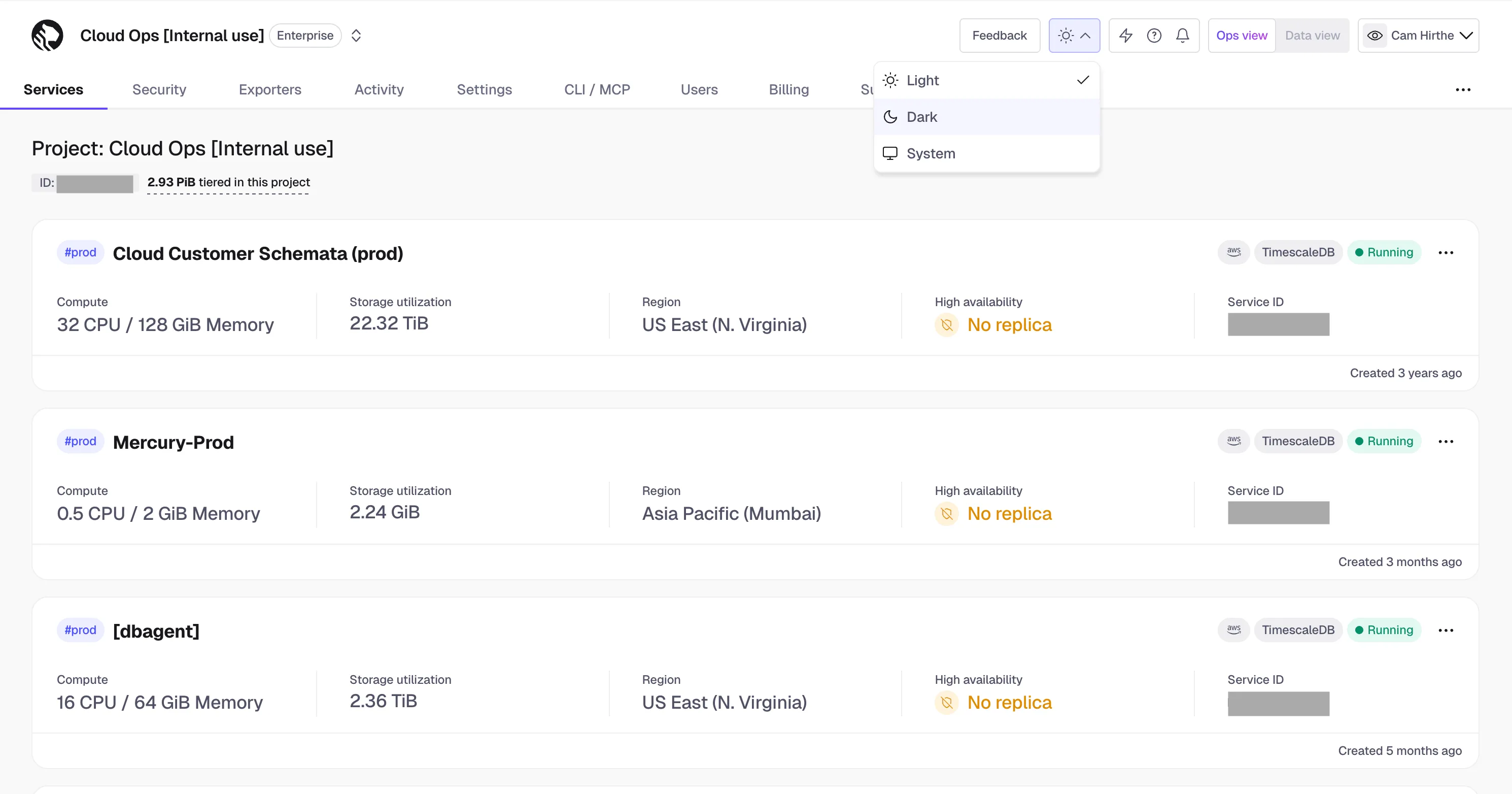
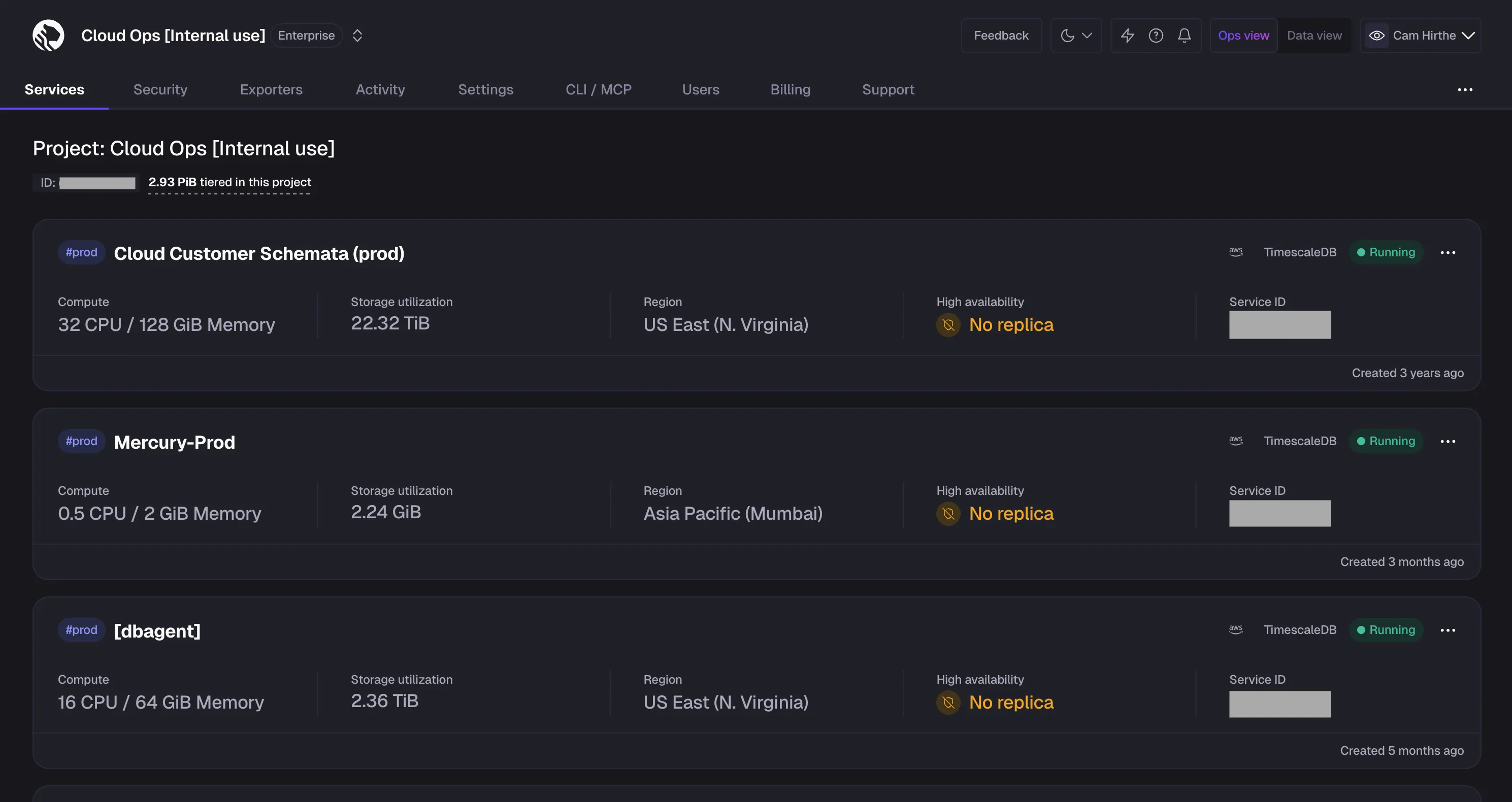
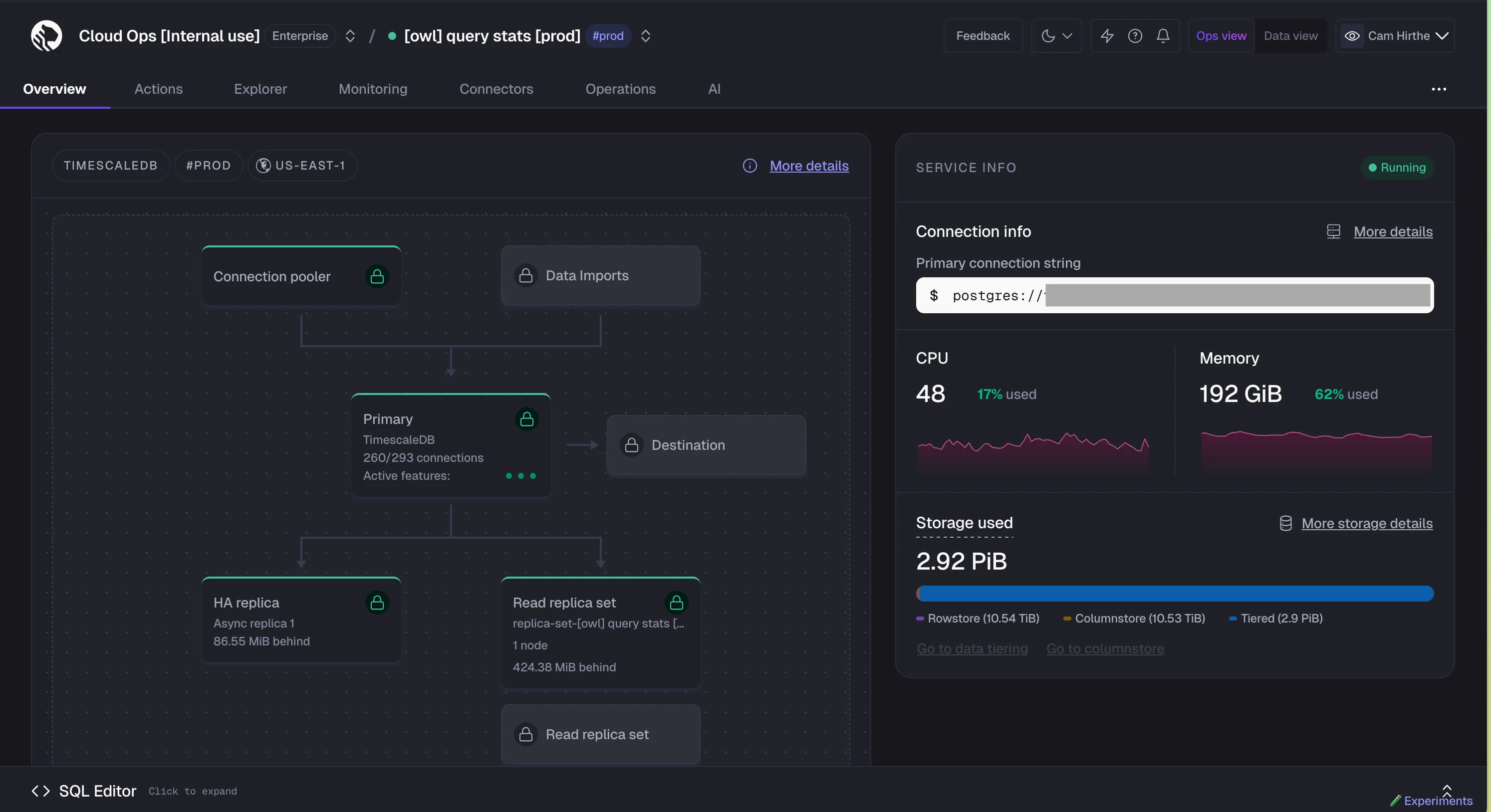
Dark mode is now live in Tiger Console for all customers. Switch themes from the theme toggle in the top navigation — choose Light, Dark, or System to match your OS preference.
The default remains light mode for now, with an upcoming update planned to follow the user’s system preference by default.
TimescaleDB v2.26.3 is a bug-fix release focused on operational reliability, with the most important improvement addressing concurrent refreshes of continuous aggregates. It was released on April 14, 2026, and was made available on Tiger Cloud right after release.
This release fixes concurrent refresh issues for continuous aggregates, an important improvement for production workloads that run overlapping or adjacent refreshes.
Fix concurrent refreshes of continuous aggregates: Resolves issues seen when multiple CAgg refreshes run at the same time. The underlying fix replaces the earlier intermediate queue model with a new registration-based approach for refresh windows, adds better overlap detection, uses lock-skipping to avoid deadlocks, and ensures cleanup happens correctly even when refreshes are cancelled or interrupted.
Why it matters: The previous design could lead to deadlocks between overlapping refreshes and leave stale ranges behind when refreshes were interrupted. The new model makes concurrent refresh behavior safer and more predictable.
Additional bug fixes
Fix alter_job for retention policies with drop_created_before: Resolves a failure case when updating retention policies with this argument.
Fix cleanup of orphaned compression_chunk_size entries during extension upgrade: Improves upgrade reliability.
Fix resource leaks during continuous aggregate refresh: Addresses error-path leaks during CAgg refresh processing.
Fix gapfill DST bucket ordering issue: Resolves out-of-order bucket creation during DST shifts in gapfill queries.
TimescaleDB v2.26.2 continues the 2.26 stabilization work with a broader set of fixes across query correctness, memory safety, chunk pruning, and continuous aggregates. It was released on April 7, 2026, and was made available on Tiger Cloud right after release.
This release improves correctness and stability for a number of query patterns introduced or expanded in recent releases.
Fix chunk exclusion with mutable expressions: Resolves a wrong-result issue when performing chunk exclusion using a mutable expression.
Fix chunk skipping with dropped columns: Improves correctness for chunk pruning in schemas that include dropped columns.
Fix GROUP BY ROLLUP on compressed continuous aggregates: Addresses an issue affecting this query pattern on compressed CAggs.
Reliability and memory-safety fixes
Fix WAL record tracking in EXPLAIN for direct compress: Corrects WAL tracking shown in EXPLAIN for direct compress workflows.
Fix several use-after-free issues: Includes fixes for invalidation handling, job owner validation, and reorder_chunk, improving overall runtime safety.
The Tiger Cloud platform status page has been migrated to status.tigerdata.com. The new status page is tightly integrated with our incident response workflows to provide better visibility into service health, including historical uptime. You can subscribe to be notified whenever an incident is created, updated, and resolved.
TimescaleDB v2.26.1 is a small follow-up release focused on stability. It was released on March 30, 2026, and was made available on Tiger Cloud right after release.
TimescaleDB v2.26 continues improving how TimescaleDB scales for real-world analytical workloads, with major gains in columnstore query performance, better filtering efficiency on compressed data, and practical query-planning improvements that reduce unnecessary work. TimescaleDB 2.26.0 was released on March 24, 2026, and is available on GitHub and on Tiger Cloud as of March 30, 2026.
This release expands the vectorized query path so more analytical queries can stay on the high-performance columnar execution engine instead of falling back to slower row-based processing.
Vectorized PostgreSQL functions in aggregation paths: Queries that use functions like time_bucket() in grouping or aggregation expressions can now continue running in the columnar pipeline. This delivers significantly faster performance for common analytical patterns, with benchmark examples showing roughly 3.5x faster execution on affected workloads.
Faster MIN()/MAX() on text columns:MIN() and MAX() on text columns using C collation now run natively in the vectorized aggregation path, avoiding row-based fallback and improving performance for workloads that use text values as tie-breakers or grouping outputs.
Faster summary-style queries on compressed data
TimescaleDB 2.26 enables a new fast path for common aggregate and “latest/earliest value” queries on compressed chunks.
ColumnarIndexScan enabled by default: First introduced in 2.25.0 and now enabled by default in 2.26, this execution path allows queries using COUNT, MIN, MAX, and partial FIRST/LAST to read directly from sparse min/max metadata instead of decompressing full batches. This substantially improves performance for common summary queries on the columnstore, with benchmark examples showing speedups of up to 70x+.
Better filtering and UPSERT performance with composite bloom filters
This release improves how TimescaleDB prunes compressed batches when queries or conflict checks involve multiple columns.
Composite bloom filters: Multi-column predicates can now be pushed down directly into compressed scans for both SELECT and UPSERT operations.
This helps avoid unnecessary decompression, improving efficiency for workloads with selective multi-column lookups and conflict-heavy writes.
Benchmark examples show 2x+ faster performance when composite bloom filters apply.
EXPLAIN plans now surface more details to help you understand pruning effectiveness.
Smarter chunk exclusion
This release improves query planning so TimescaleDB can skip more irrelevant chunks earlier.
Runtime chunk exclusion on nested loop joins: Chunk exclusion now applies on the inner side of nested loop joins, reducing unnecessary scans for join-heavy workloads.
Chunk exclusion for IN/ANY on open time dimensions: Queries using these predicate patterns can now benefit from pruning as well, reducing wasted work on large datasets.
Quality of life and operability
Safer extension re-creation in-session:CREATE EXTENSION timescaledb now works correctly after DROP EXTENSION in the same session.
More reliable chunk creation in replication edge cases: Fixes a failure mode tied to replica identity invalidation.
Improved background worker reliability: Advisory locks were removed from background worker job coordination and replaced with graceful cancellation logic, reducing contention and deadlock risk under concurrency.
Internal catalog cleanup: Removes a dropped column from _timescaledb_catalog.chunk; if you query internal catalog tables directly, update any dependencies.
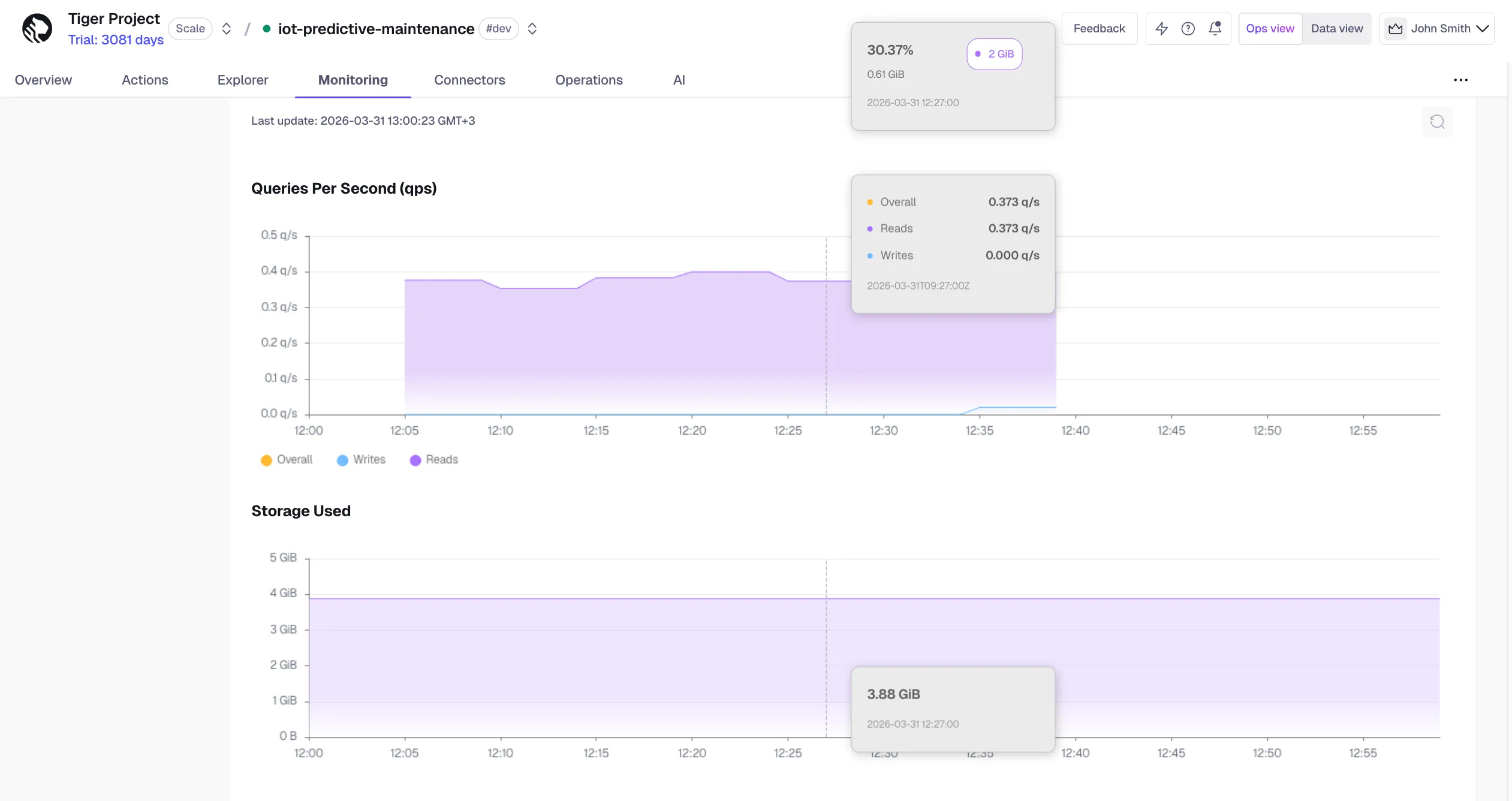
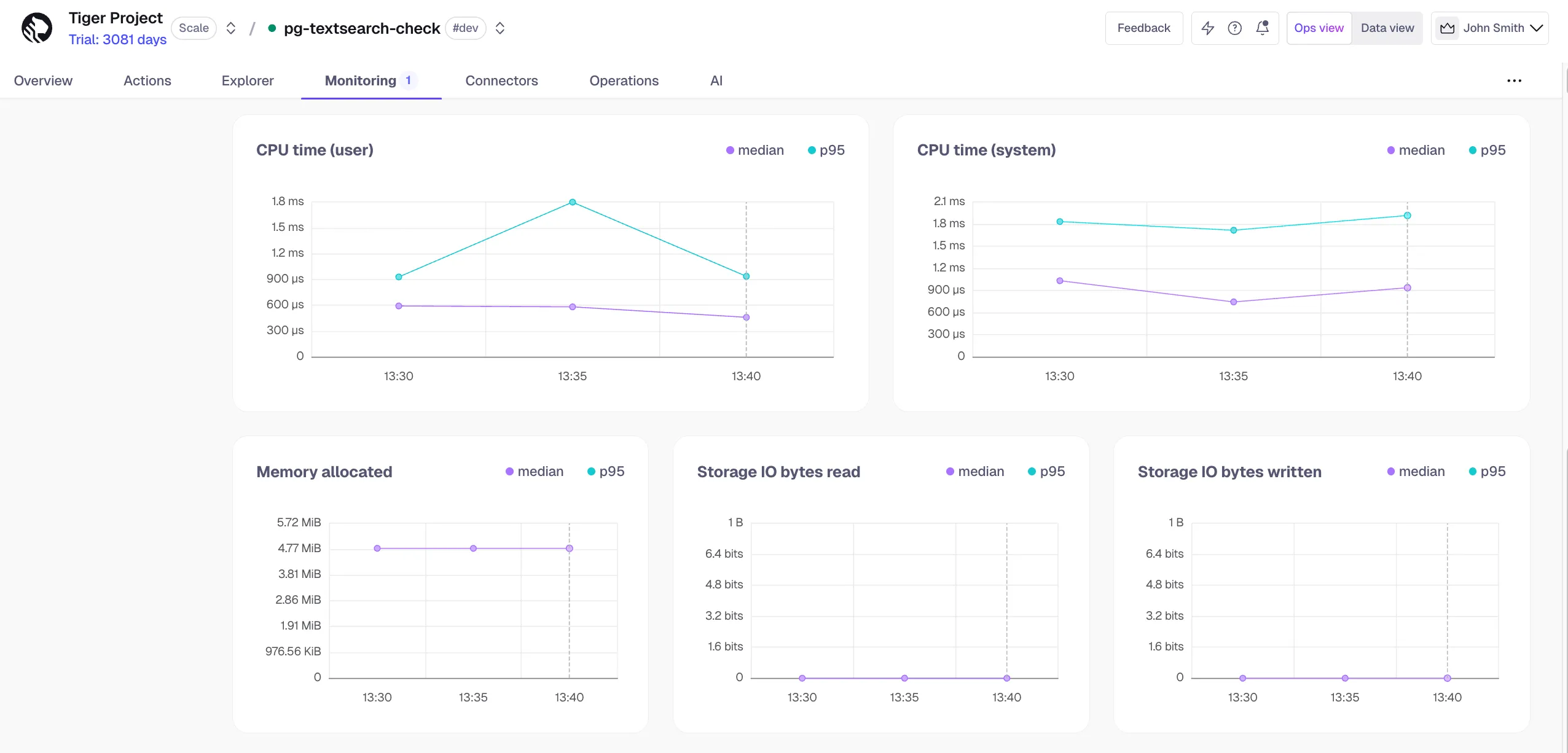
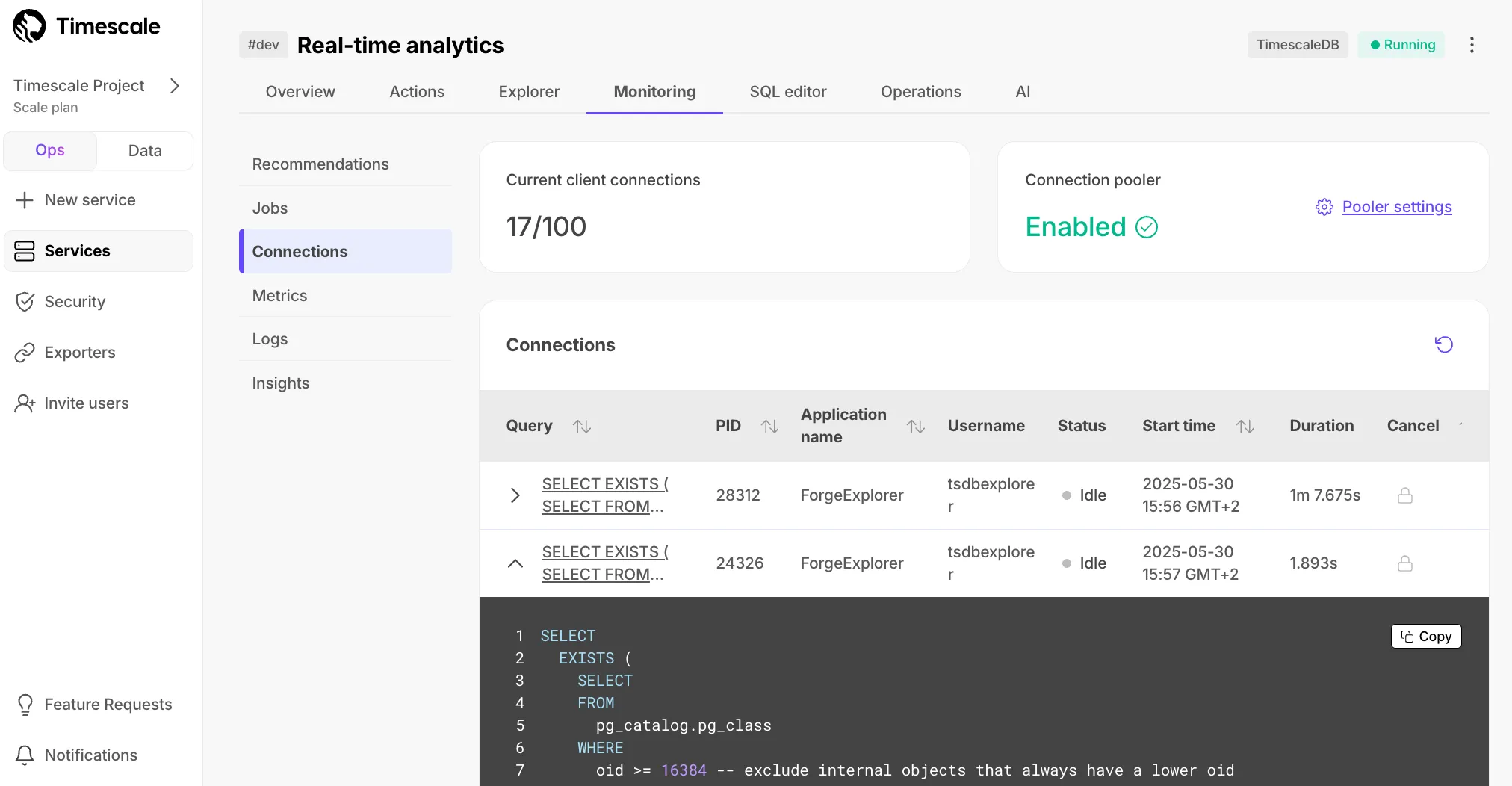
Several new graphs are now available to help you monitor database performance and resource usage over time.
In Metrics, a new Queries per Second graph gives you a real-time view of your database’s throughput, making it easier to spot unexpected spikes or drops in query volume.
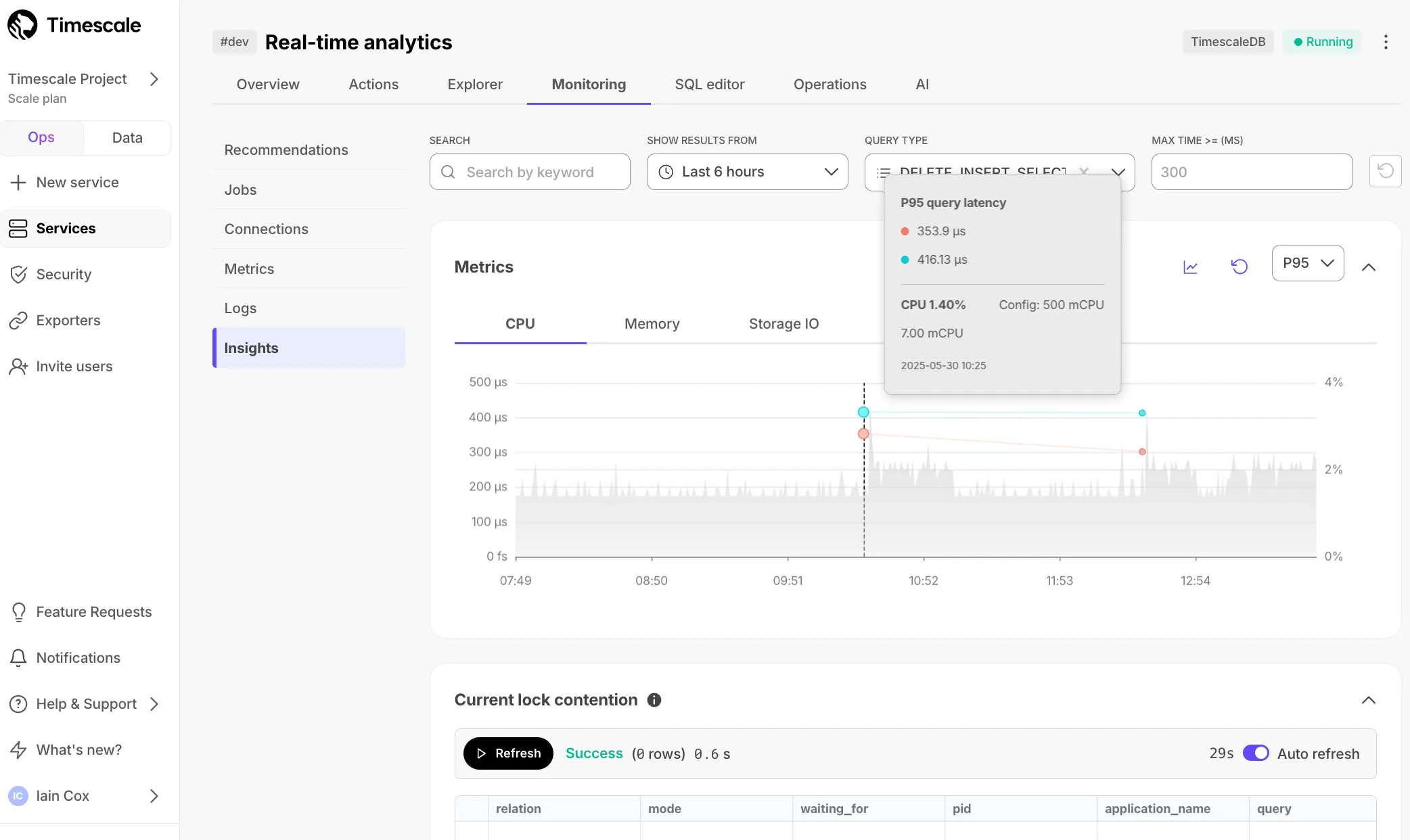
In Insights, the query deep dive page now includes resource consumption metrics — CPU, memory, and storage IO (read and write) — tracked over time. Use this to identify whether a query’s performance is improving or degrading, and to understand the downstream impact of your queries on overall system health.
pg_textsearch v1.0.0 is generally available and production-ready on Tiger Cloud. This release marks BM25 full-text search as supported for production workloads, with documentation and operations guidance aligned to GA. This includes implicit <@> query syntax, bm25_force_merge() for segment consolidation, expanded configuration and limitations, and PostgreSQL 17–18 compatibility.
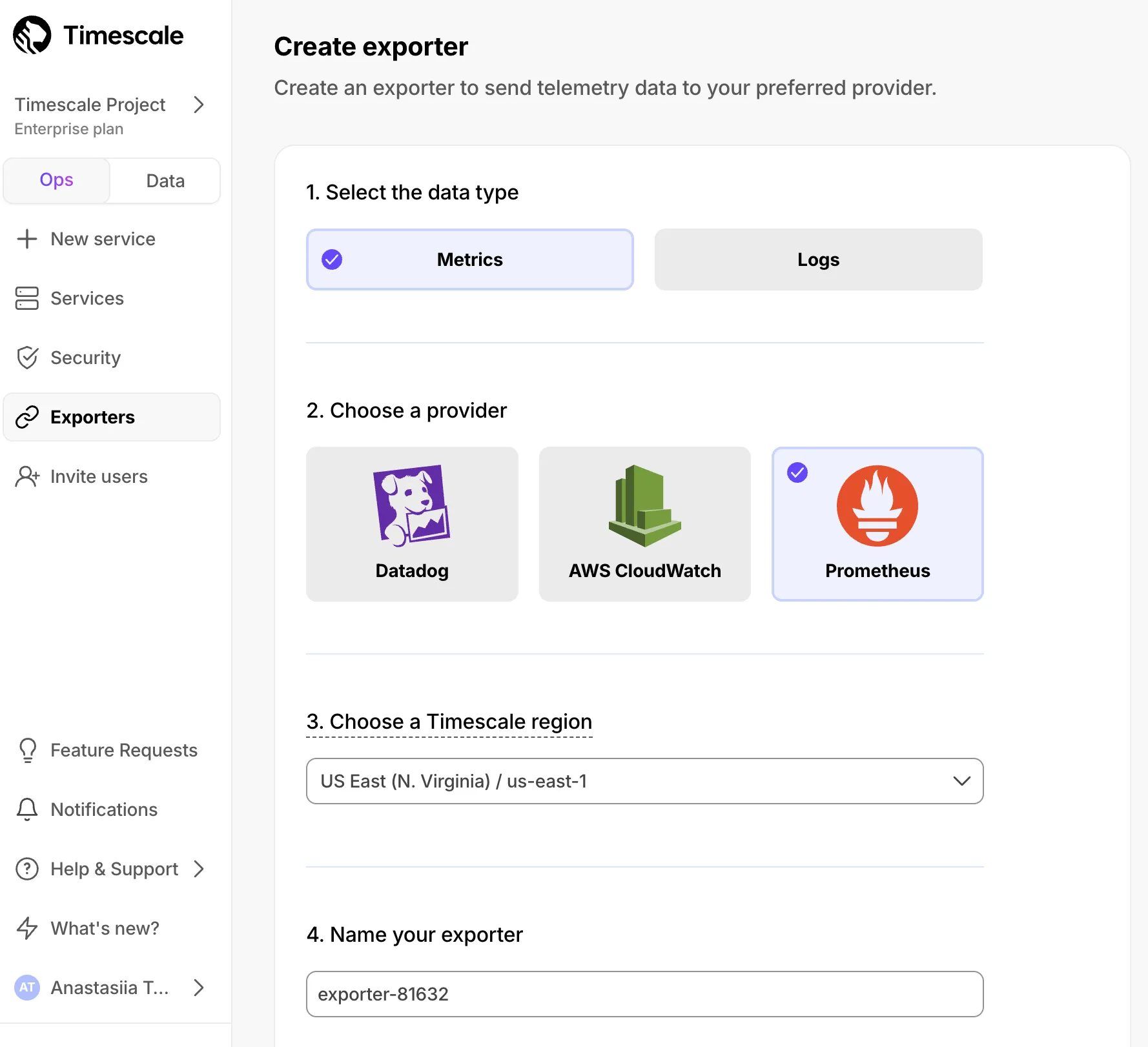
You can now enable the export of database metrics such as replication, cache usage, and background activity to Amazon CloudWatch, Datadog, and Prometheus by selecting PostgreSQL metrics when creating or modifying an exporter in Tiger Console. Additionally, system-level disk metrics such as IO and throughput are now being exported by default.
Tiger Cloud now offers support for exporting telemetry data from your Tiger Cloud services with the time-series and analytics capability enabled to Azure Monitor.
To learn more, see Integrate Azure Monitor with Tiger Cloud.
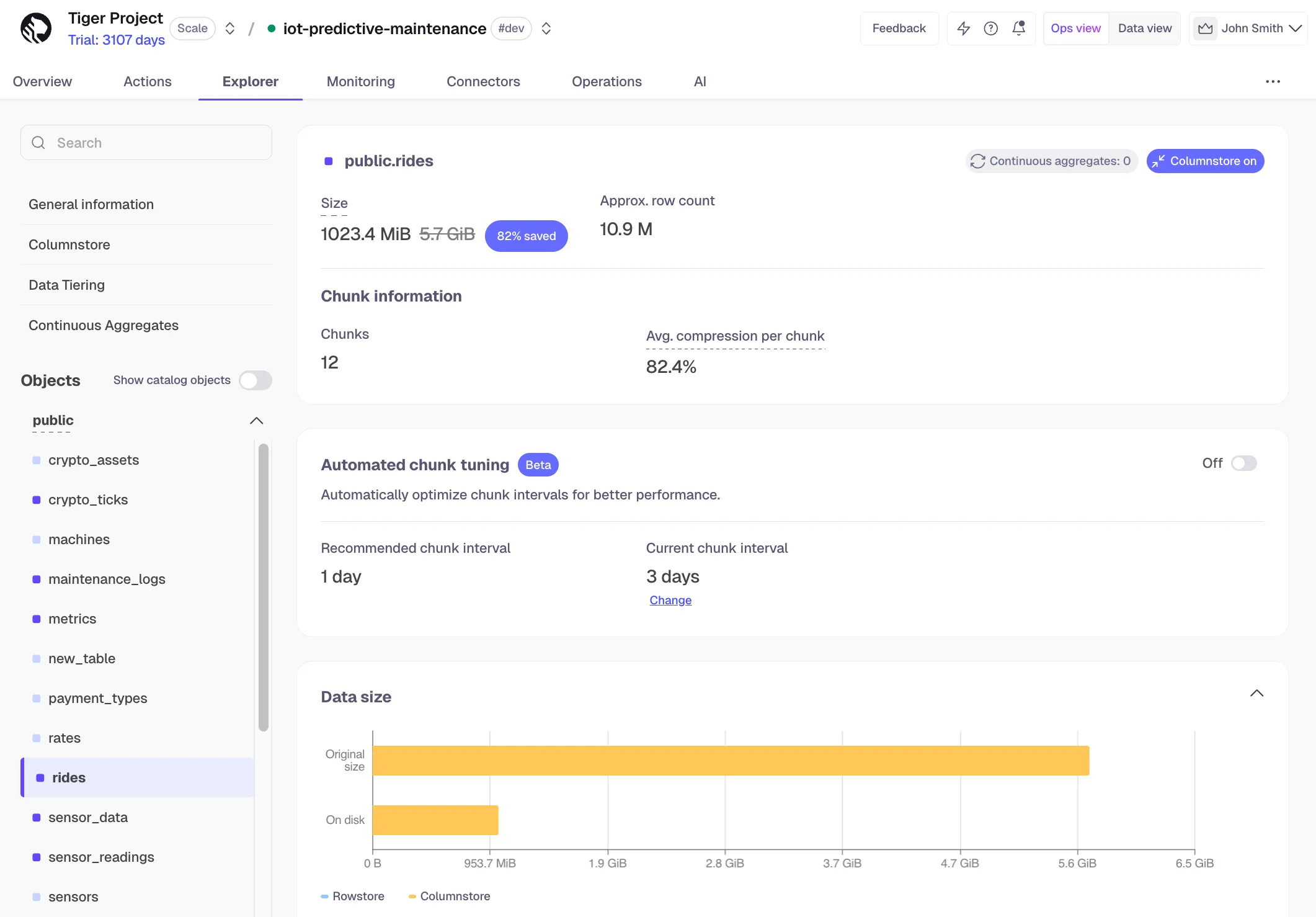
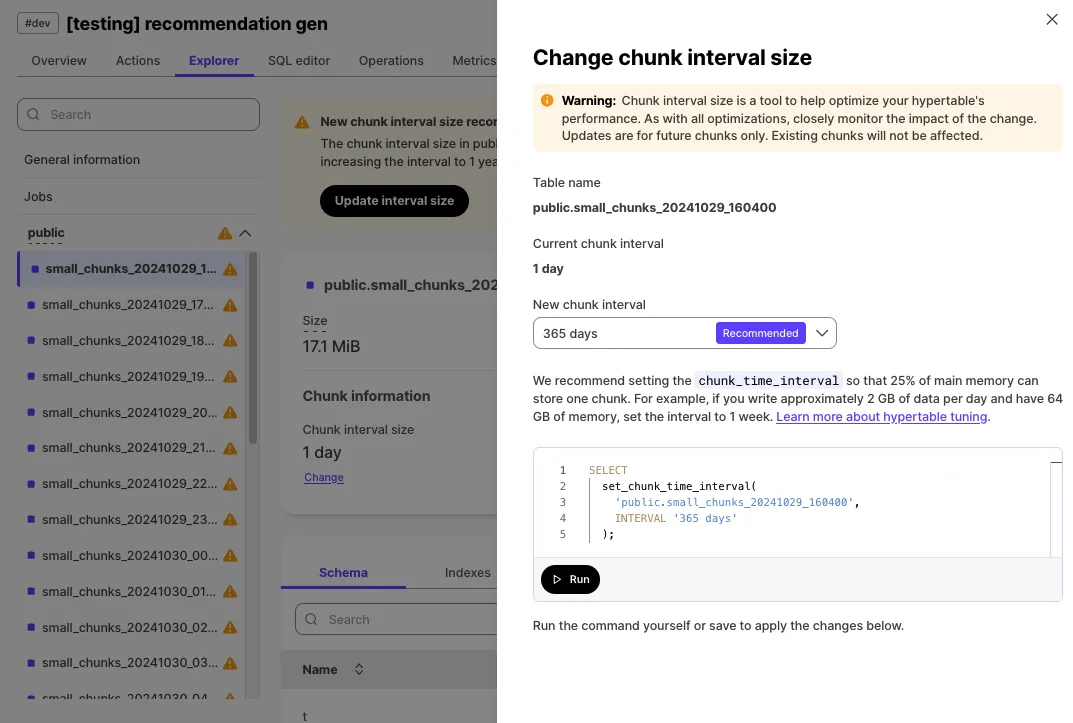
Tiger Cloud now offers automated chunk tuning in beta, taking the guesswork out of setting and maintaining chunk intervals for your hypertables. When enabled, the tuner monitors your workload and adjusts chunk intervals automatically, no manual intervention required.
Per-hypertable opt-in: disabled by default, automated chunk tuning can be enabled for individual hypertables in the Explorer.
Recommendations for all users: even without enabling automated tuning, you can view the recommended chunk interval for any hypertable in the Explorer.
Gradual, safe adjustments: the tuner moves chunk intervals incrementally to avoid disruptive jumps, and will never increase an interval beyond your configured compression lookback.
Activity log integration: chunk interval changes are recorded in the Activity log for a full audit trail.
No instance overhead: all calculations run outside your service via Schemata.
If you experience any negative impact, you can opt out at any time and manually reset the interval via the UI or SQL. Learn more about automated chunk tuning.
TimescaleDB v2.25 continues improving how PostgreSQL scales for time-series workloads, with major wins in query performance on compressed data, smoother continuous aggregate refresh behavior, and practical operational improvements as datasets and chunk counts grow. TimescaleDB 2.25 was released on January 29, 2026, and is now available to all users on Tiger Cloud.
A new ColumnarIndexScan execution path uses columnar metadata to accelerate common aggregates and FIRST/LAST queries on compressed chunks. The feature is currently disabled by default due to a known issue with partial aggregations, but can be enabled by setting the GUC enable_columnarindexscan to true. It will be enabled by default in 2.26.
MIN/MAX/FIRST/LAST on compressed data can take fast paths and avoid scanning full chunks (reported up to 289× faster in the example).
COUNT(*) with time filters can often skip reading the time column entirely (reported up to 50× faster in the example), reducing CPU and memory pressure.
Continuous aggregates
This release reduces contention and refresh overhead for continuous aggregates, especially when using the columnstore.
Direct compress on continuous aggregate refresh (GUC, off by default) writes refresh results directly to the columnstore, bypassing the rowstore step that can cause policy contention and temporary storage overhead. This also reduces WAL activity, and will be enabled by default in an upcoming release.
Direct batch delete restores a key columnstore optimization for DELETEs on compressed hypertables: when conditions allow, it can delete whole batches without decompressing and deleting row-by-row. Previously, this path was disabled for tables with continuous aggregates because it didn’t emit the invalidation details needed to trigger the right refresh ranges. In 2.25, that support is added, so hypertables using the columnstore and continuous aggregates can benefit from faster, lower-I/O deletes.
Smaller, steadier refresh transactions by default: continuous aggregate refreshes can be broken into smaller “batches,” where each batch refreshes a portion of the overall time range. This keeps materialization results (and transactions) smaller, reducing stress on the service and improving predictability under heavy refresh/backfill patterns. The default buckets_per_batch is now 10 (previously 1, effectively no batching).
Safer defaults for continuous aggregates using the columnstore: we’ve seen cases where columnstore-backed CAggs can time out during refresh due to suboptimal defaults. This release removes the automatic assignment of segmentby for columnstore CAggs (effectively using no segmentby) and sets the orderby column to the bucketing timestamp to improve refresh behavior.
Quality of life/operability
Estimate original size for columnstore chunks to support workflows that depend on pre-compression sizing (for example, tiering/billing and Console reporting), especially as direct compress becomes more common and raw-size stats may not exist. This also improves accuracy versus older “frozen” compression stats that didn’t reflect subsequent DML (like deletes).
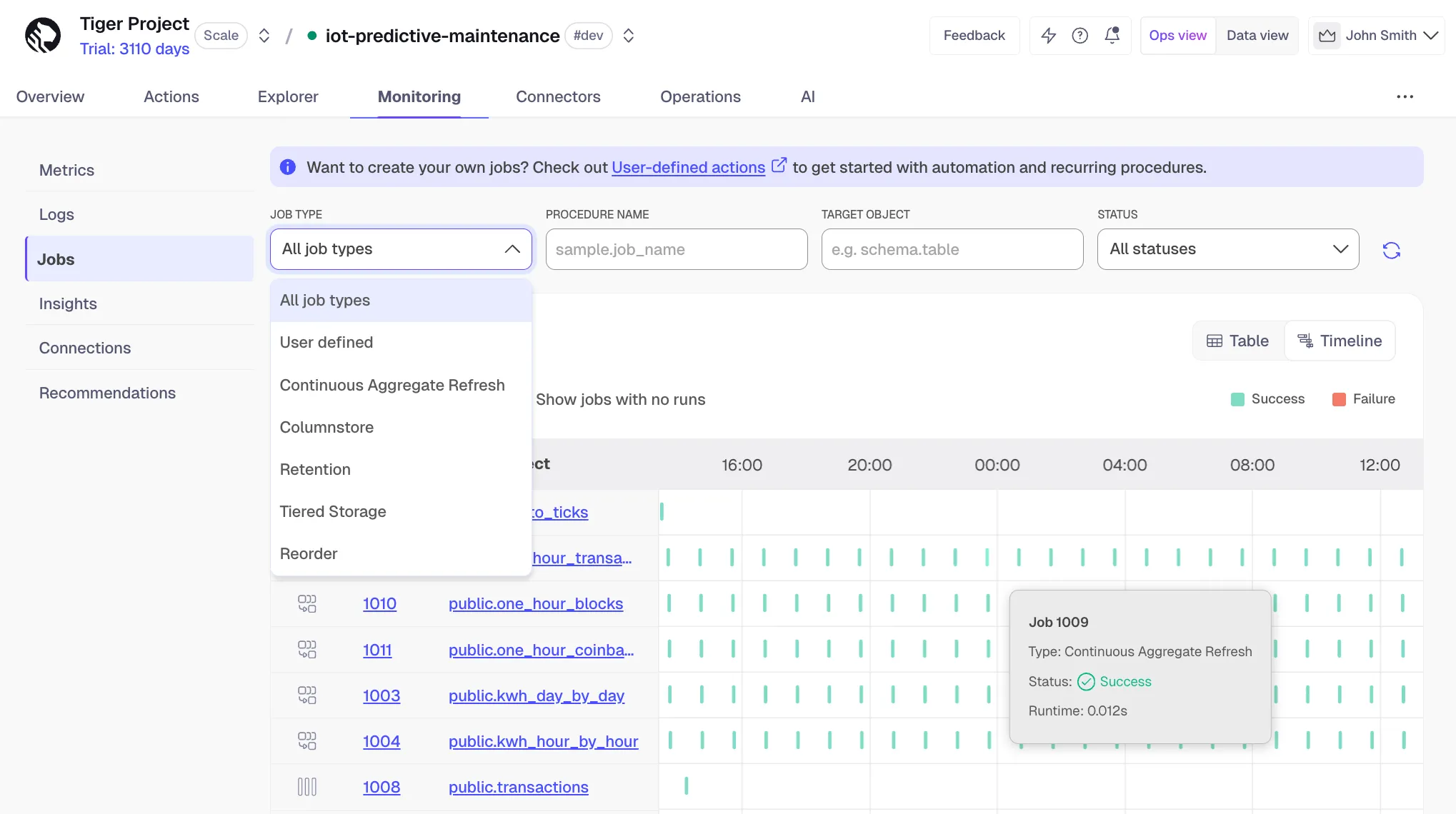
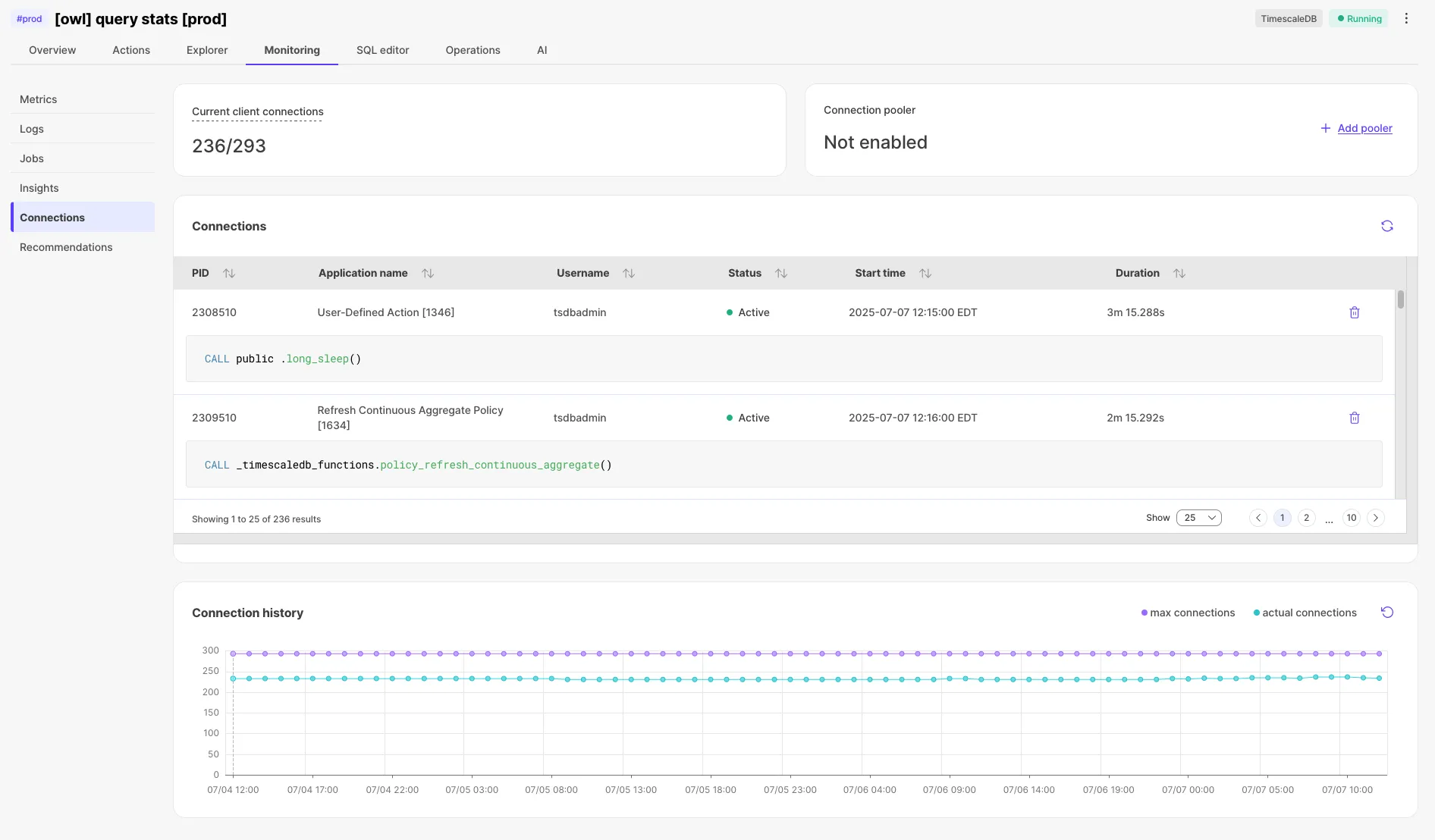
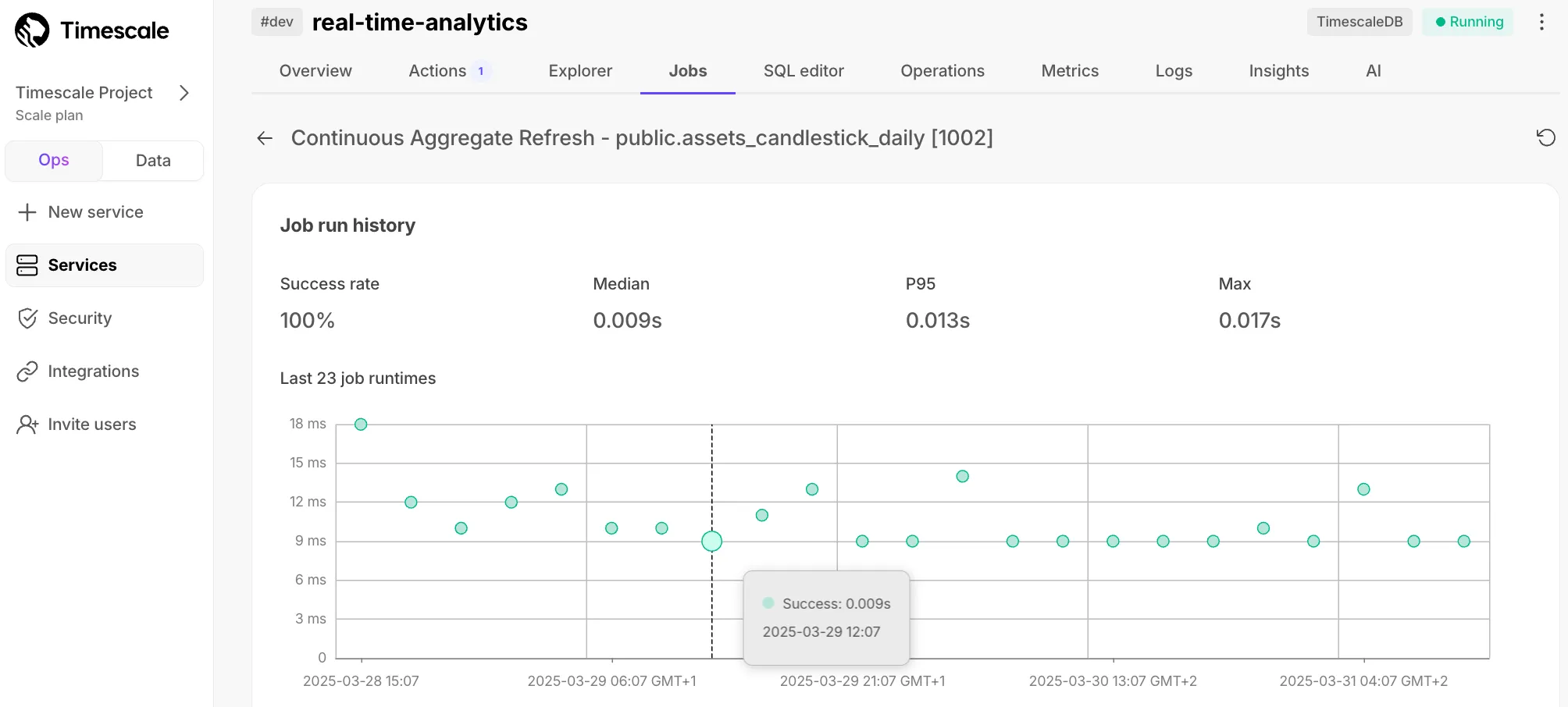
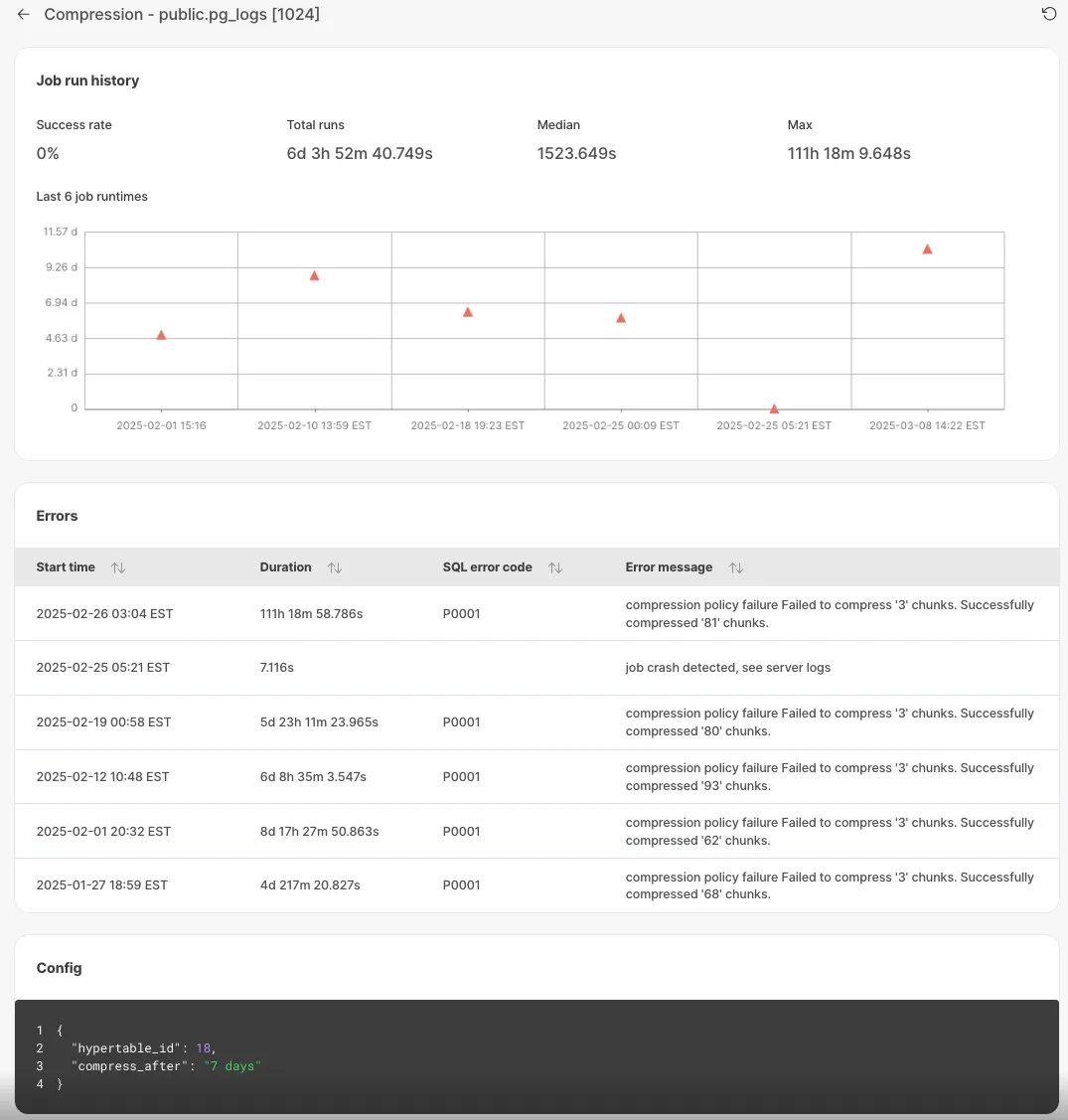
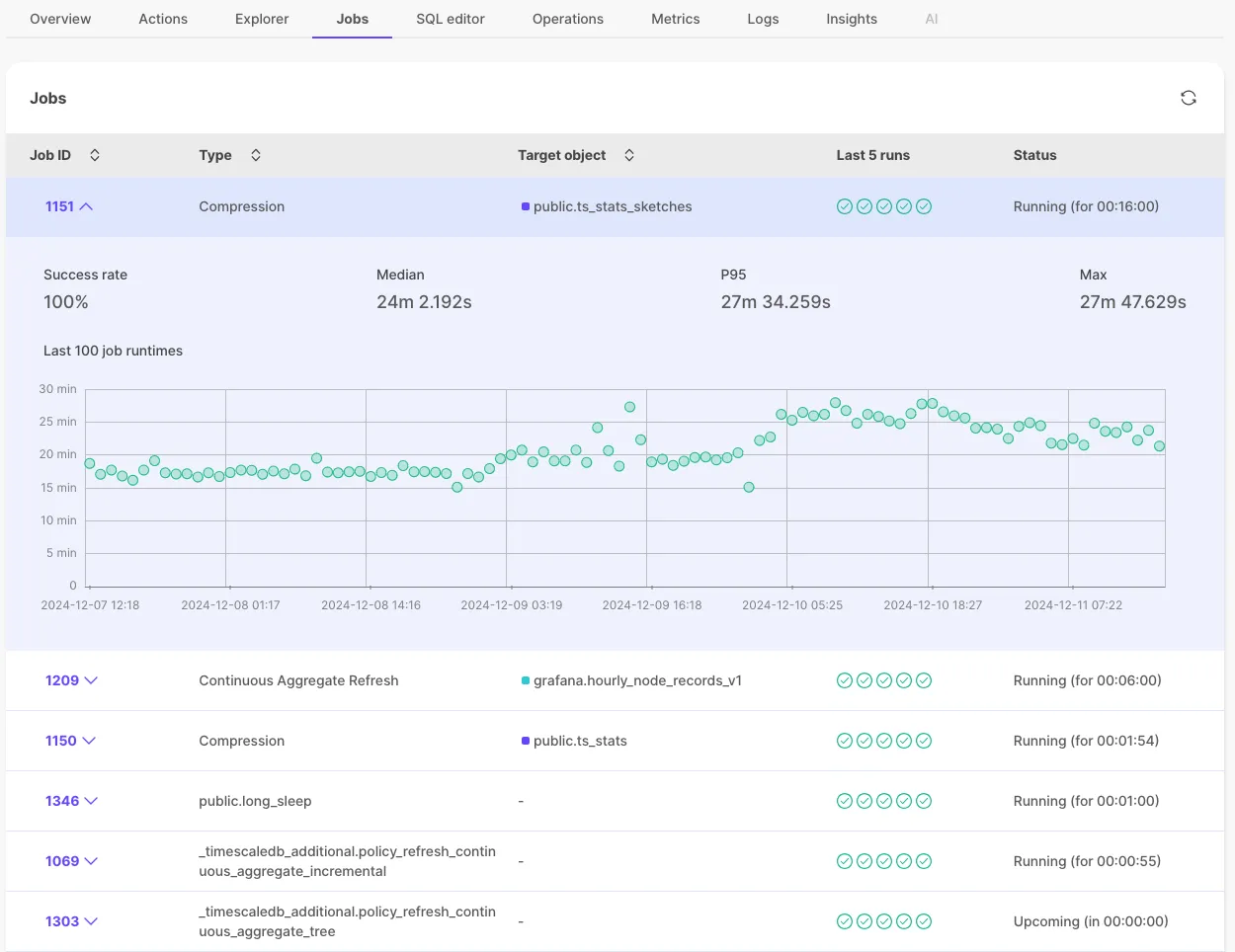
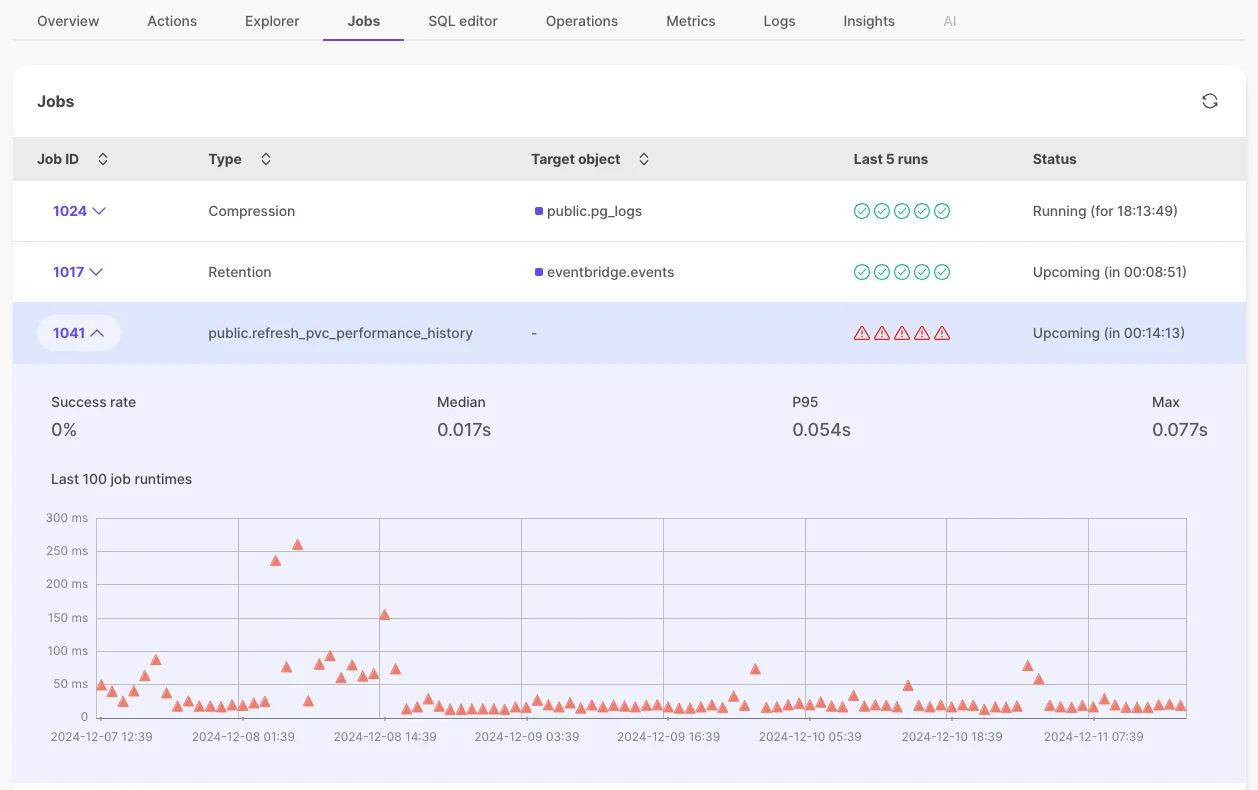
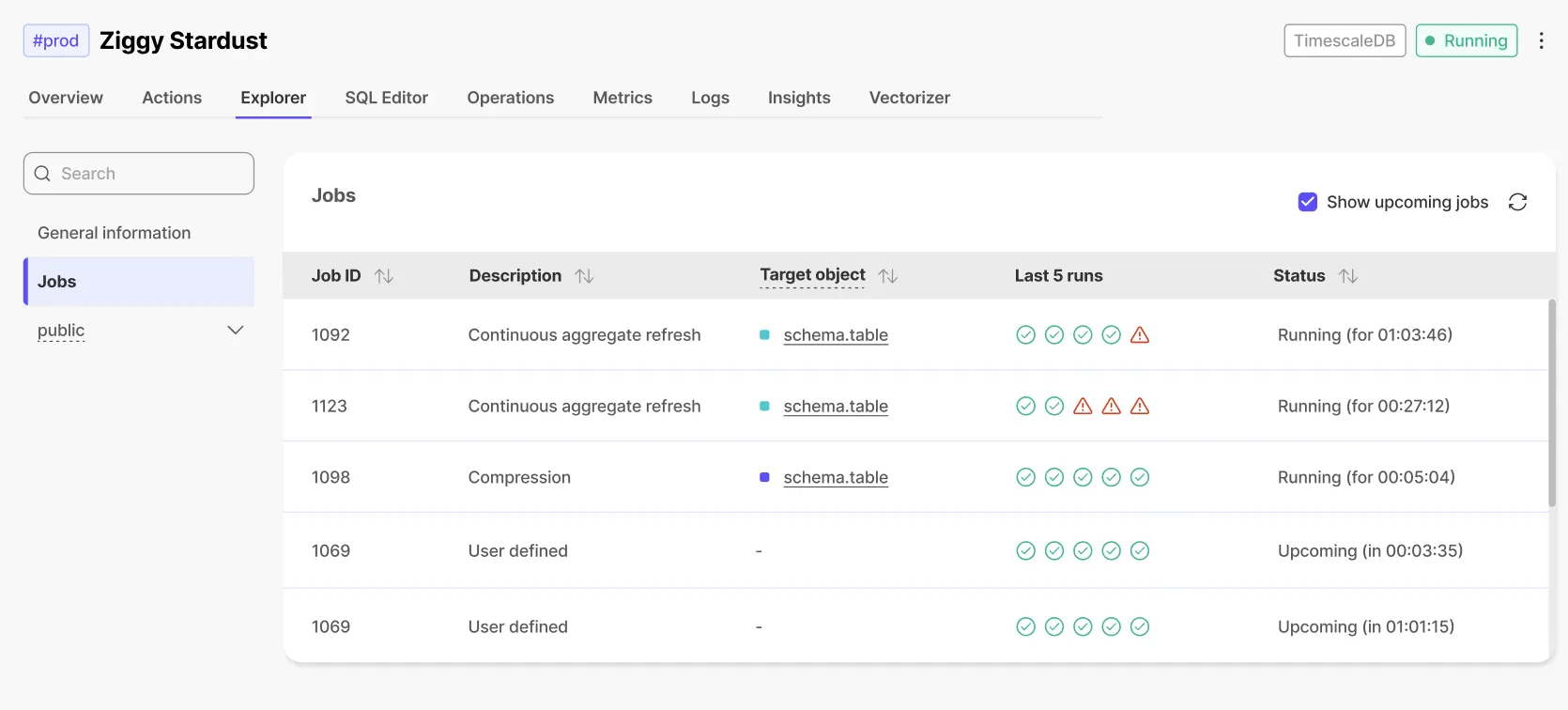
We have added a timeline view to the Jobs page so you can easily see the status of all of your recent job runs at a glance. Hover over each run for more detail, or click on a specific job to go into the deep dive jobs view. See Monitor your Tiger Cloud services.
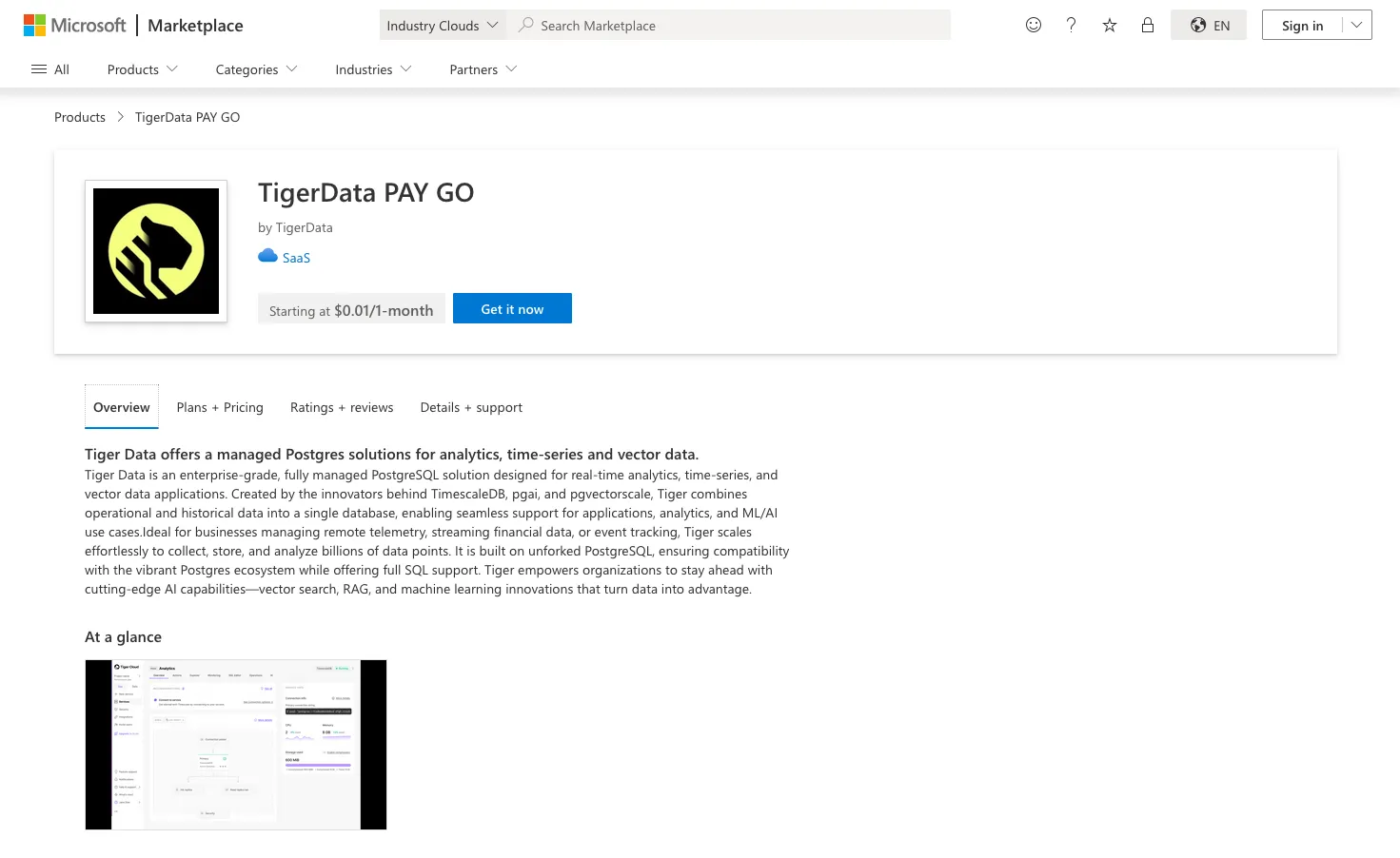
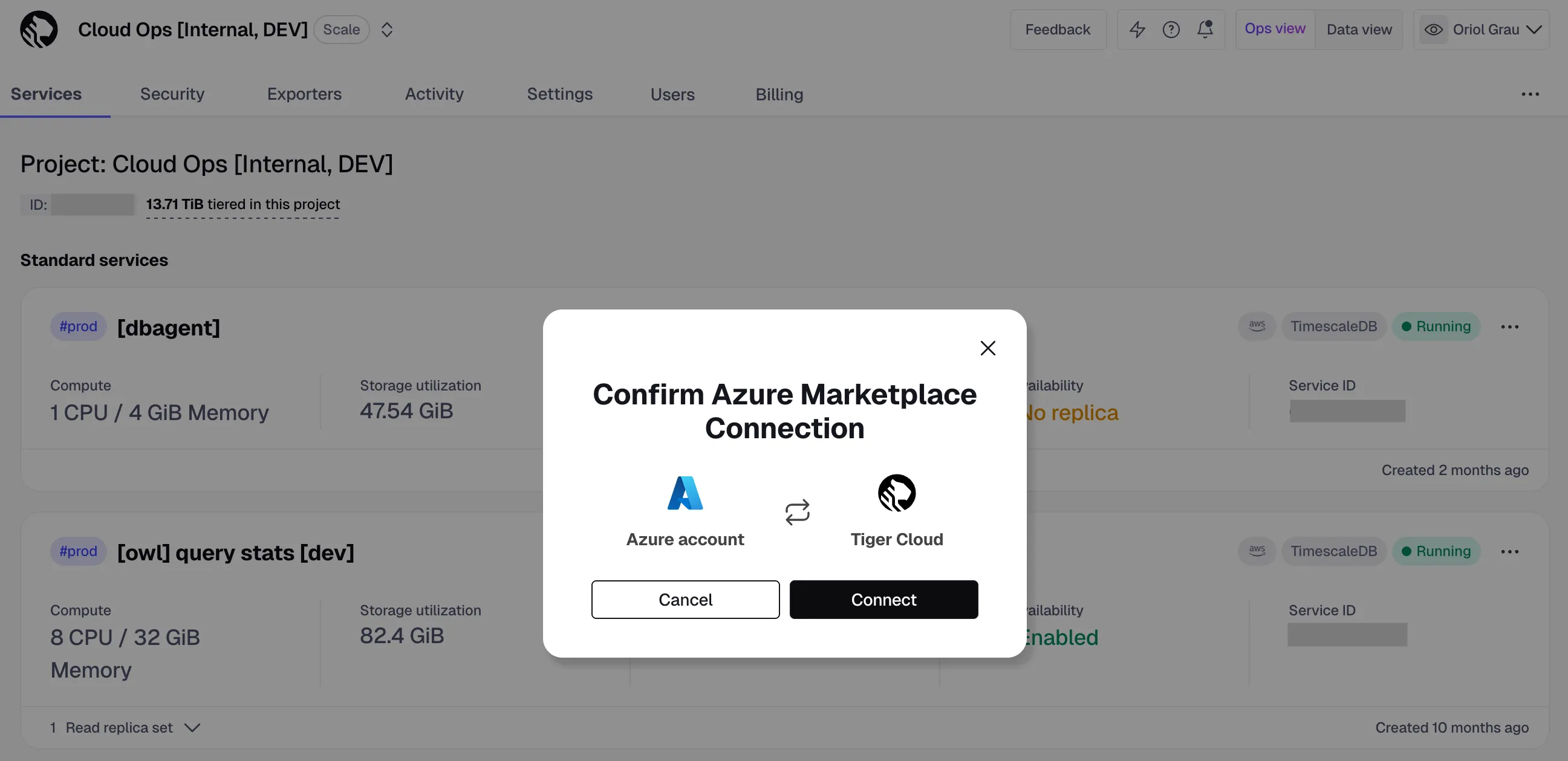
Microsoft customers can quickly sign up for Tiger Cloud through Azure Marketplace, enabling streamlined procurement and consolidated billing. Previously the signup process was manual, requiring help from us at Tiger Data. Now it’s completely self-serve! You can find the product under the annual commit and pay as you go pricing options at the marketplace.
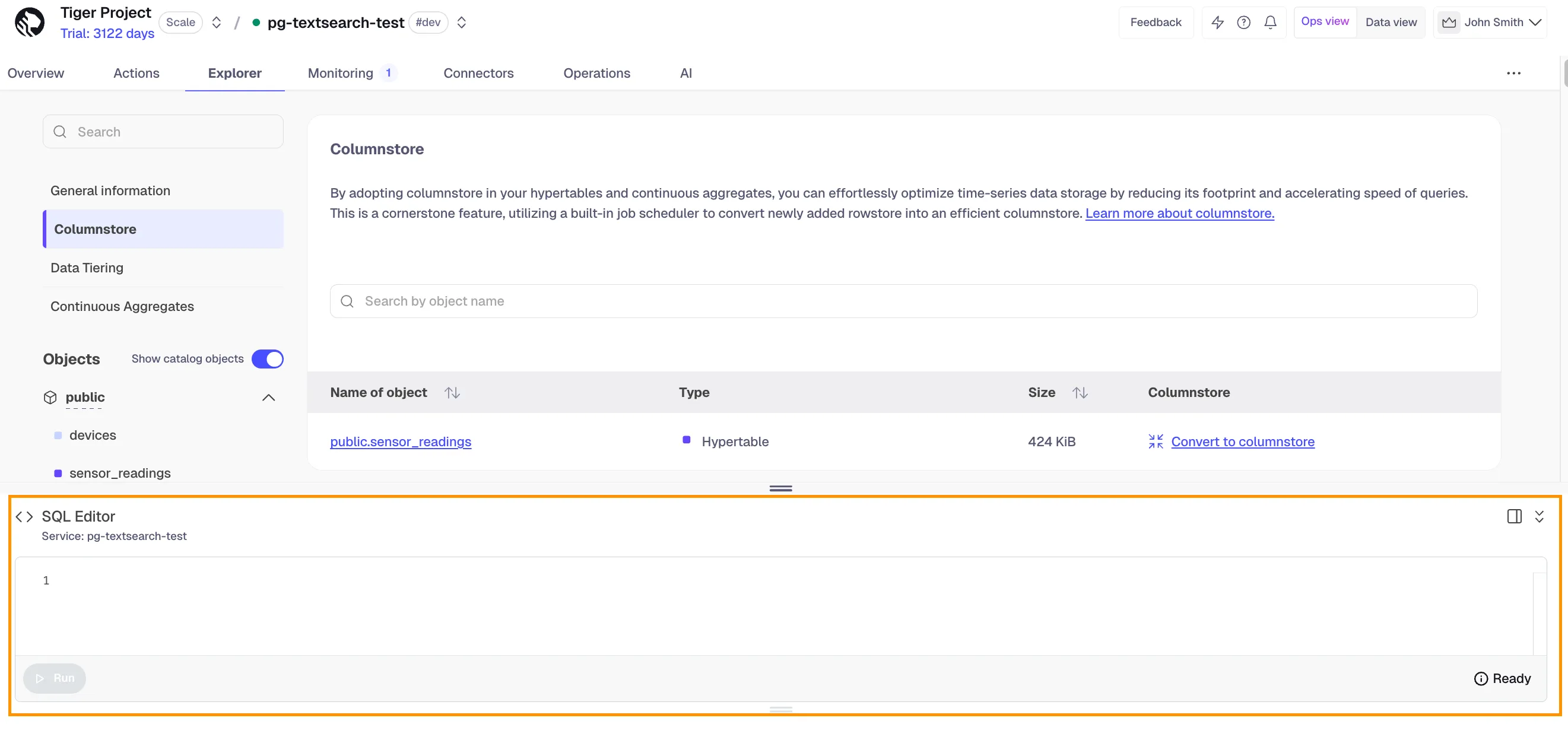
We have changed the interface for the SQL editor to be floating, as opposed to a dedicated tab. Now SQL editor follows you as you navigate around the UI within an individual service. This change improves the usability and allows you to easily reference your schema (through Explorer) when writing SQL queries.
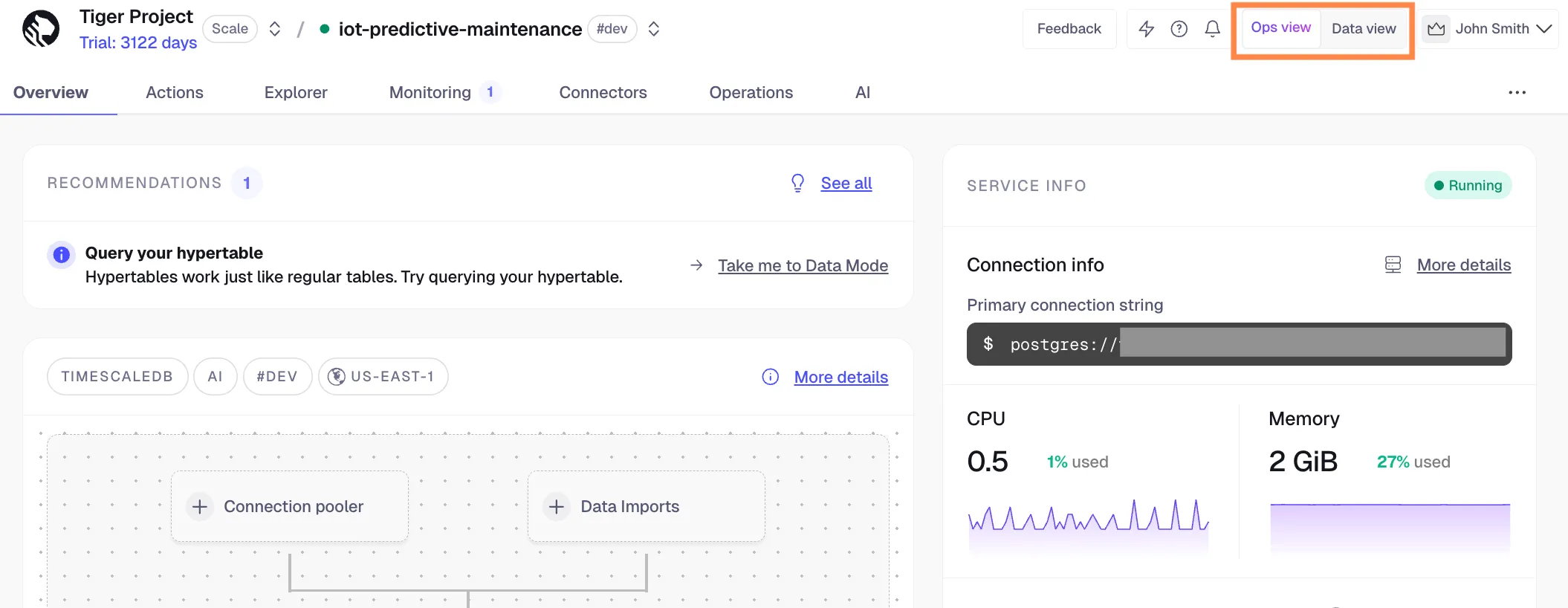
We brought back the toggle between the Ops view and Data view within the context of a service. You can now easily switch to Data view from inside an individual service. The toggle is available above the top navigation in the UI.
pg_textsearch v0.5.0 is now available on Tiger Cloud.
This release includes the following highlights:
Parallel index builds: CREATE INDEX now uses multiple workers for faster indexing of large tables. PostgreSQL automatically allocates workers based on the table size and the max_parallel_maintenance_workers setting.
Tiered Storage is now available for Tiger Cloud services running on Microsoft Azure, bringing cost-effective data management to our Azure customers. This feature enables you to automatically move rarely accessed data to low-cost storage on Azure Blob Storage while maintaining the ability to query it seamlessly with standard SQL. Customers typically see a reduction of 2-5x in storage costs depending on data compression rates.
Azure Tiered Storage works just like the AWS version: enable it in Tiger Console, set tiering policies on your hypertables, and Tiger Cloud handles the rest. With this release, Tiger Cloud Services on Azure offer the same powerful data lifecycle management capabilities as those running on AWS.
Starting today, you can use Tiger Cloud in the AWS Europe (Zurich) Region. This enables applications to have low-latency access to Tiger Cloud services while meeting data residency requirements.
To create your first service, see Get started with Tiger Data. For a complete list of regional availability, see available regions.
Tiger Cloud now includes significant improvements to pg_textsearch, bringing major gains in query performance, index size, and scalability.
What’s new:
Block MAX-WAND ranked search (v0.3.0): Introduces the Block MAX-WAND algorithm for ranked keyword search, delivering substantial performance improvements. Query performance is now competitive with the fastest PostgreSQL-based search solutions.
Posting-list compression (v0.4.0): Reduces index sizes by 40% or more, making pg_textsearch indexes smaller and more efficient.
Improved partition handling (v0.4.0): Fixes and stability improvements for indexes on tables with large numbers of partitions.
Later releases added parallel index builds (v0.5.0) and further refinements; see the pg_textsearch changelog and v1.0.0 GA for current status.
Tiger Cloud now supports PostgreSQL 18. All new services are created with PostgreSQL 18 by default, and existing services can upgrade to PostgreSQL 18.
PostgreSQL 18 highlights include:
Asynchronous I/O (AIO) for significantly faster read-heavy workloads
Faster, less disruptive major upgrades with improved pg_upgrade capabilities
Virtual generated columns and the uuidv7() function for better UUID handling
Query performance improvements, including expanded index usage and parallel GIN index builds
Security enhancements including OAuth 2.0 authentication support
We’ve added a new timescale_connector_s3 resource to the Tiger Data Terraform provider, enabling full Infrastructure as Code management of S3 source connectors. Teams can now declaratively create, update, and manage S3 connectors supporting CSV and Parquet files, multiple auth methods, and configurable sync options.
Available in Terraform provider v2.7.0+.
The newest version of pg_textsearch has automated benchmark infrastructure, groundwork for storage and query optimizations in upcoming releases, and numerous bugfixes.
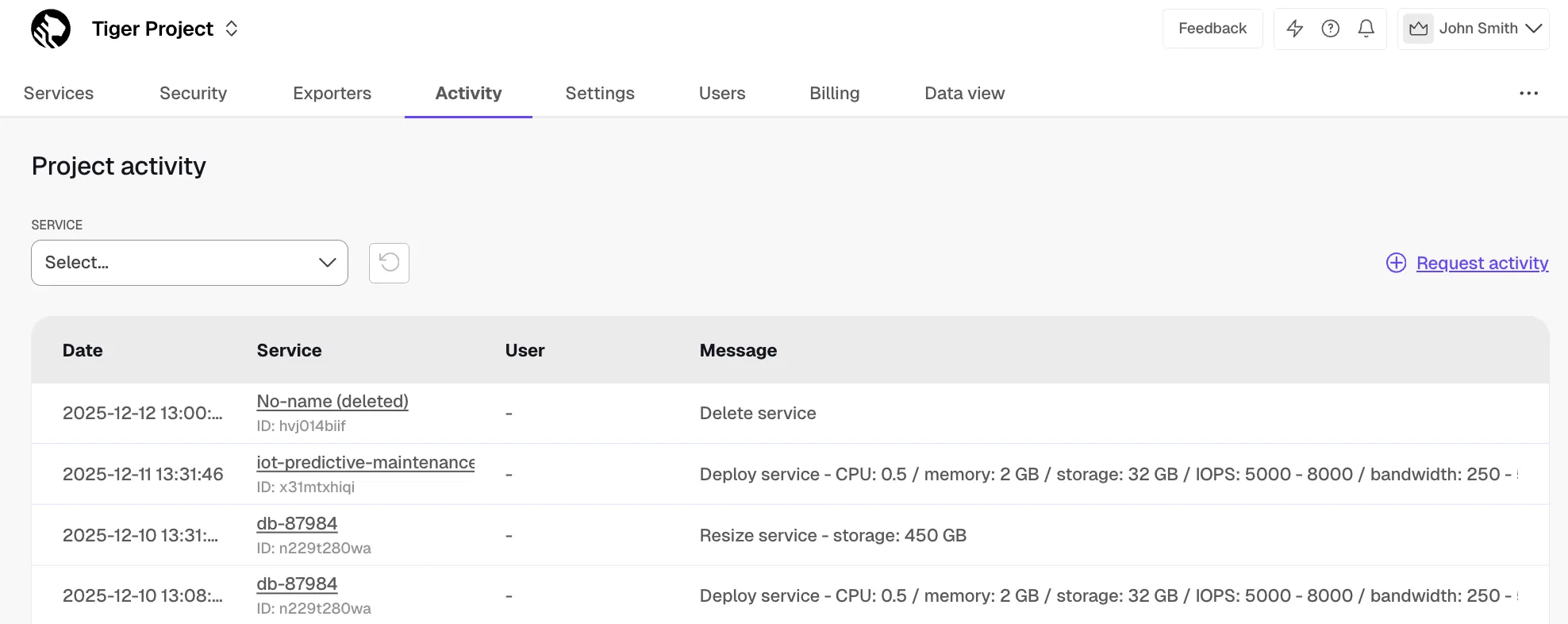
Tiger Cloud Console now offers the Activity tab that displays the activity log for all your services. This serves as a record of actions that have happened to your services and Tiger Cloud account, such as service resizes and project invitations. The activity log includes the corresponding service, the user who performed the action, and a description of the action itself.
TimescaleDB 2.24 delivers more efficient recompression operations, expanded use of continuous aggregates, and better invalidation behavior.
Highlighted features:
In-memory recompression: A new recompress := true option for convert_to_columnstore() performs batch compaction entirely in memory, offering 4–5x faster performance compared to the previous spill-to-disk method.
Bloom filters on ARM-based Tiger Cloud services: Bloom filters return with corrected hashing support for the ARM architecture.
Continuous aggregate updates: Smarter invalidation range capping, direct compress invalidation support, and UUIDv7 support for continuous aggregates.
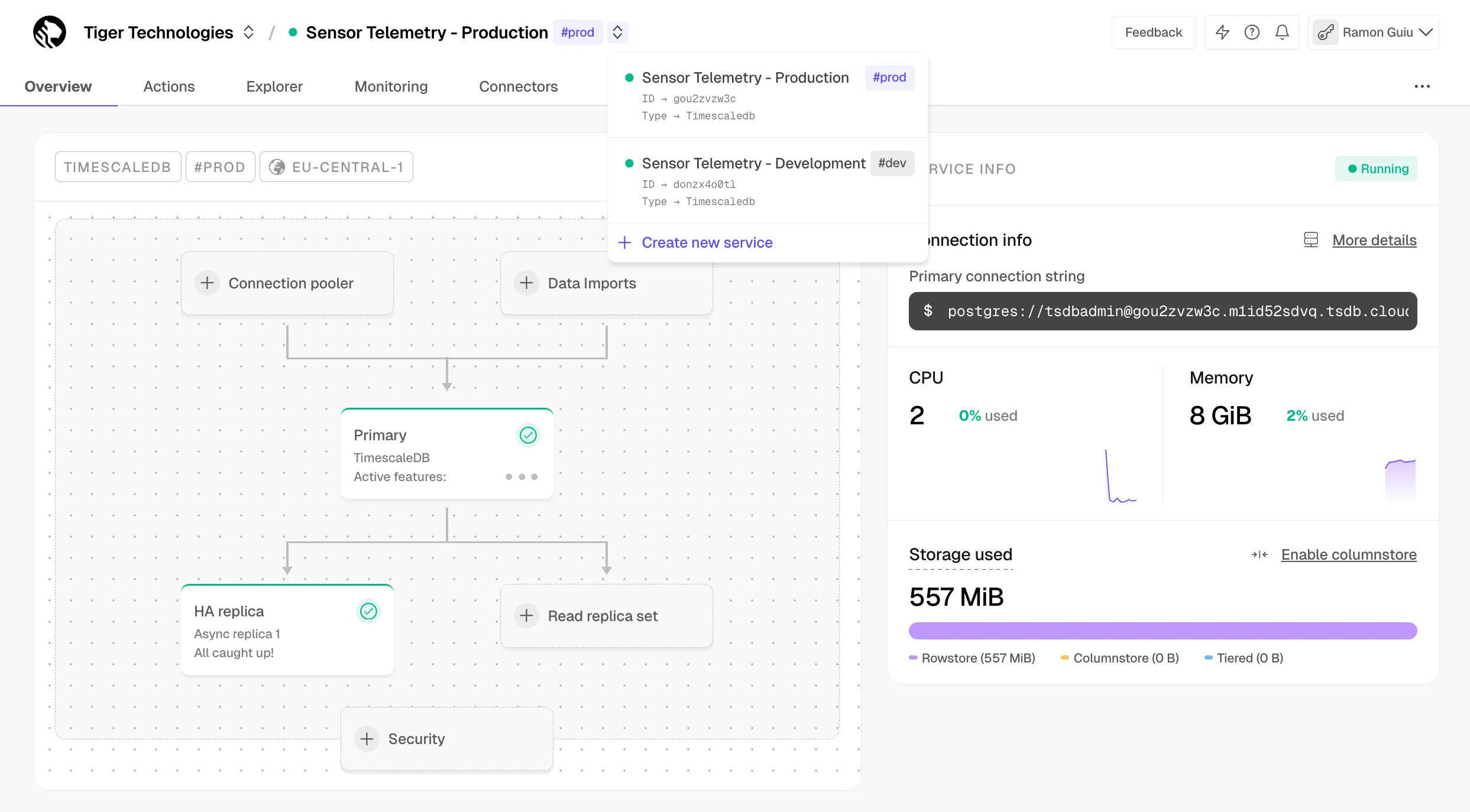
We have updated the design of the navigation in Console to improve consistency, reduce distractions, and make it easier and faster to navigate through the different menus.
The S3 source connector is now production-ready, delivering major improvements in reliability, performance, and correctness across the entire ingestion pipeline.
Tiger Lake is now available in public beta with full DML support, high-performance ingestion, enhanced resilience and self-healing, and improved deployment experience.
Major improvements to the S3 source connector with better observability including cumulative summary, search, detailed file statuses, filtering, bulk retry, lifecycle history, and auto-refresh.
Configurable sparse indexes: Manually configure sparse indexes on compressed hypertables
UUIDv7 support: Native support for UUIDv7 for compression and partitioning
Multi-column SkipScan: Support for multiple distinct keys with millisecond-fast deduplication and DISTINCT ON queries across billions of rows. Learn more in our blog post and documentation.
Compression improvements: Default segmentby and orderby settings are now applied at compression time for each chunk, automatically adapting to evolving data patterns for better performance. This was previously set at the hypertable level and fixed across all chunks.
For a comprehensive list of changes, refer to the TimescaleDB 2.22 and 2.22.1 release notes, as well as TimescaleDB 2.22.1.
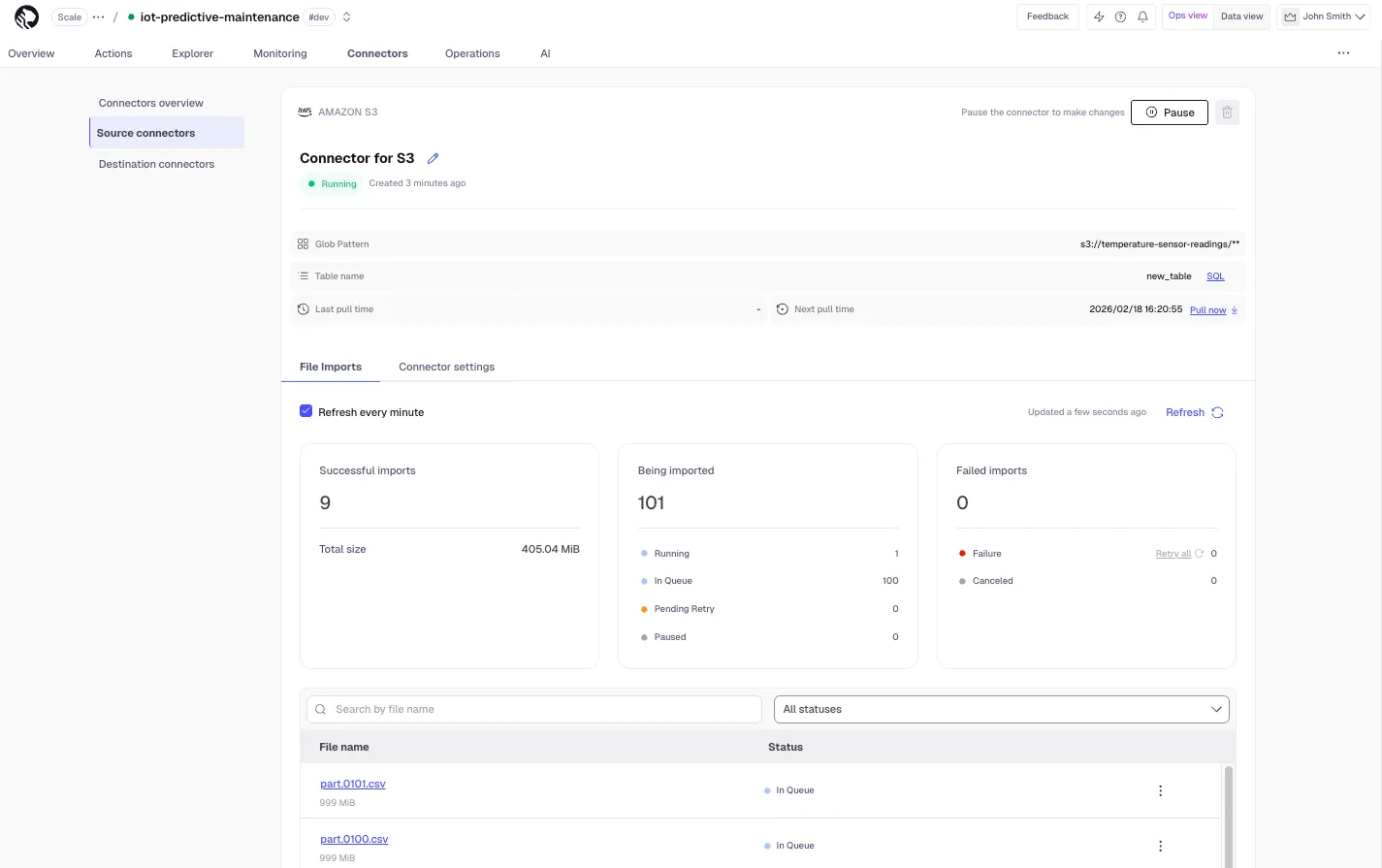
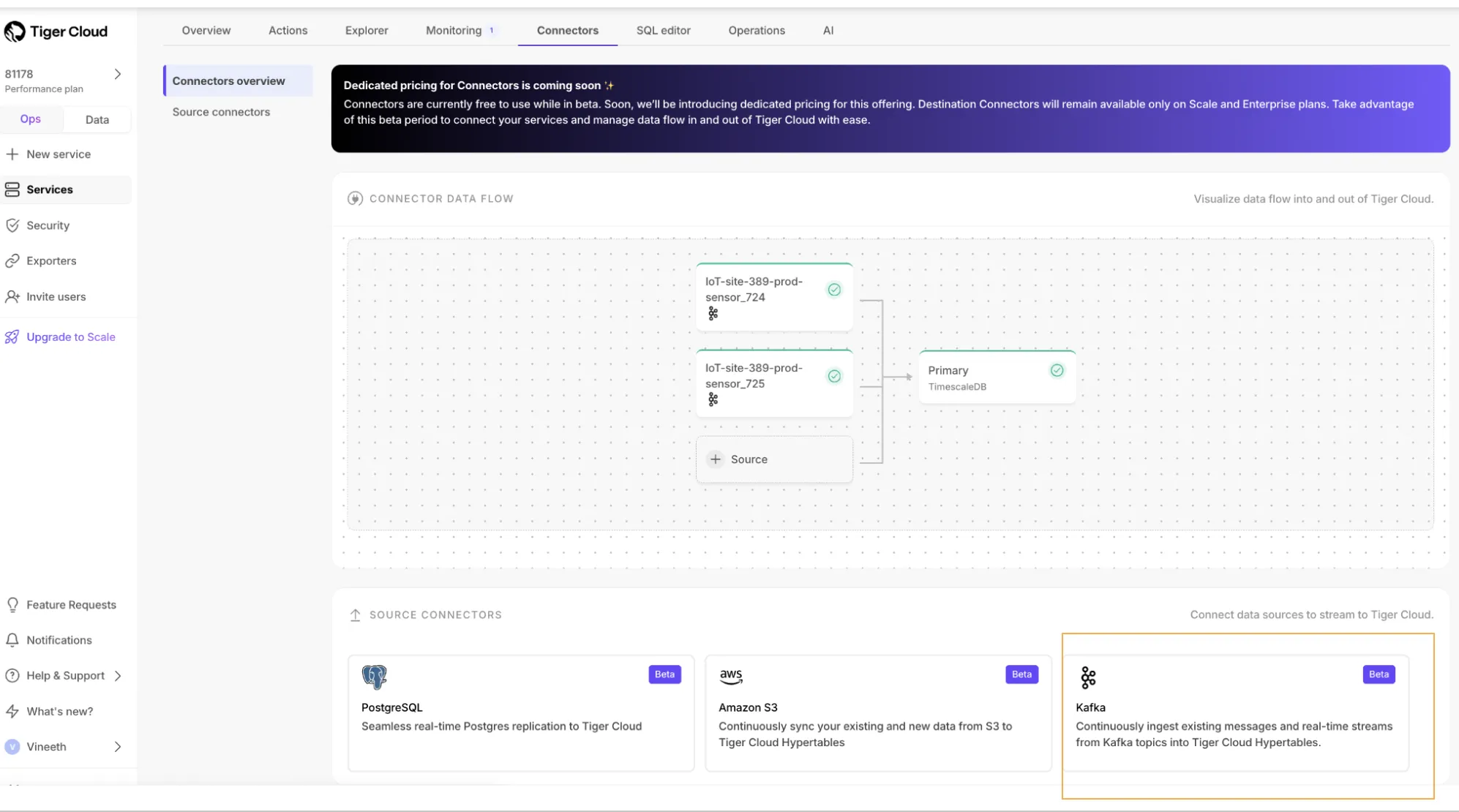
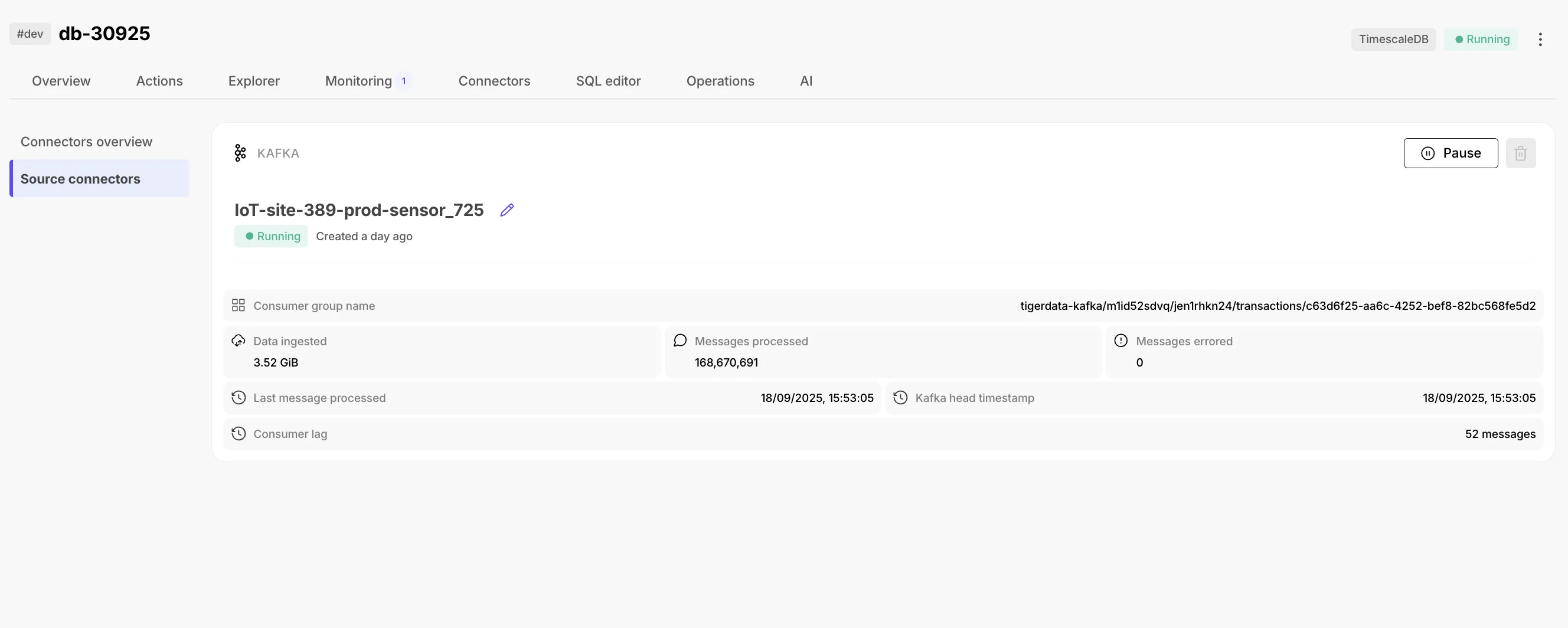
New Kafka Source Connector enables you to connect existing Kafka clusters directly to Tiger Cloud and ingest data from Kafka topics into hypertables. Supports AVRO format and Confluent Cloud and Amazon Managed Streaming for Apache Kafka.
Starting with TimescaleDB 2.22.0, minor releases roll out in phases, dev services first, followed by prod after 21 days. See Maintenance and upgrades for details.
Beta Iceberg destination connector enables Scale and Enterprise users to integrate Tiger Cloud with Amazon S3 tables. For setup details, see the Iceberg destination connector documentation.
Latest version adds support for creating and attaching observability exporters and AWS Transit Gateway configuration. Check the Timescale Terraform provider documentation for more details.
Patch release with bug fixes including SkipScan costing adjustments and dump/restore operation fixes. For a comprehensive list of changes, see the TimescaleDB 2.20.3 release notes.
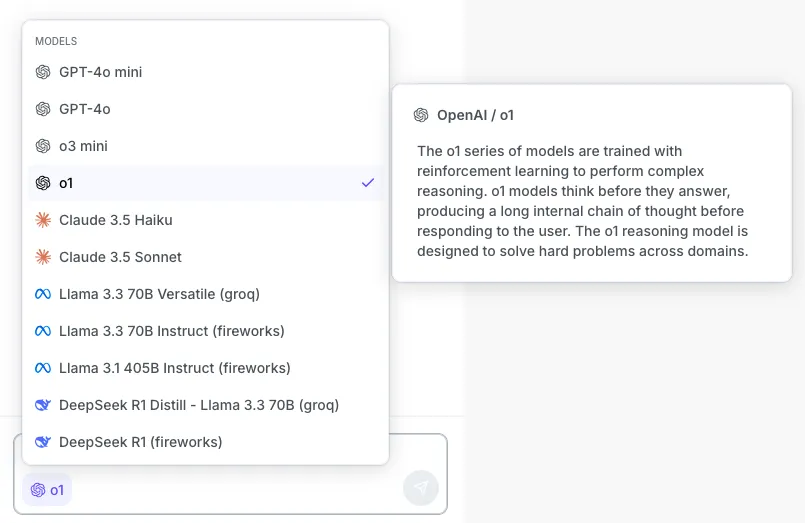
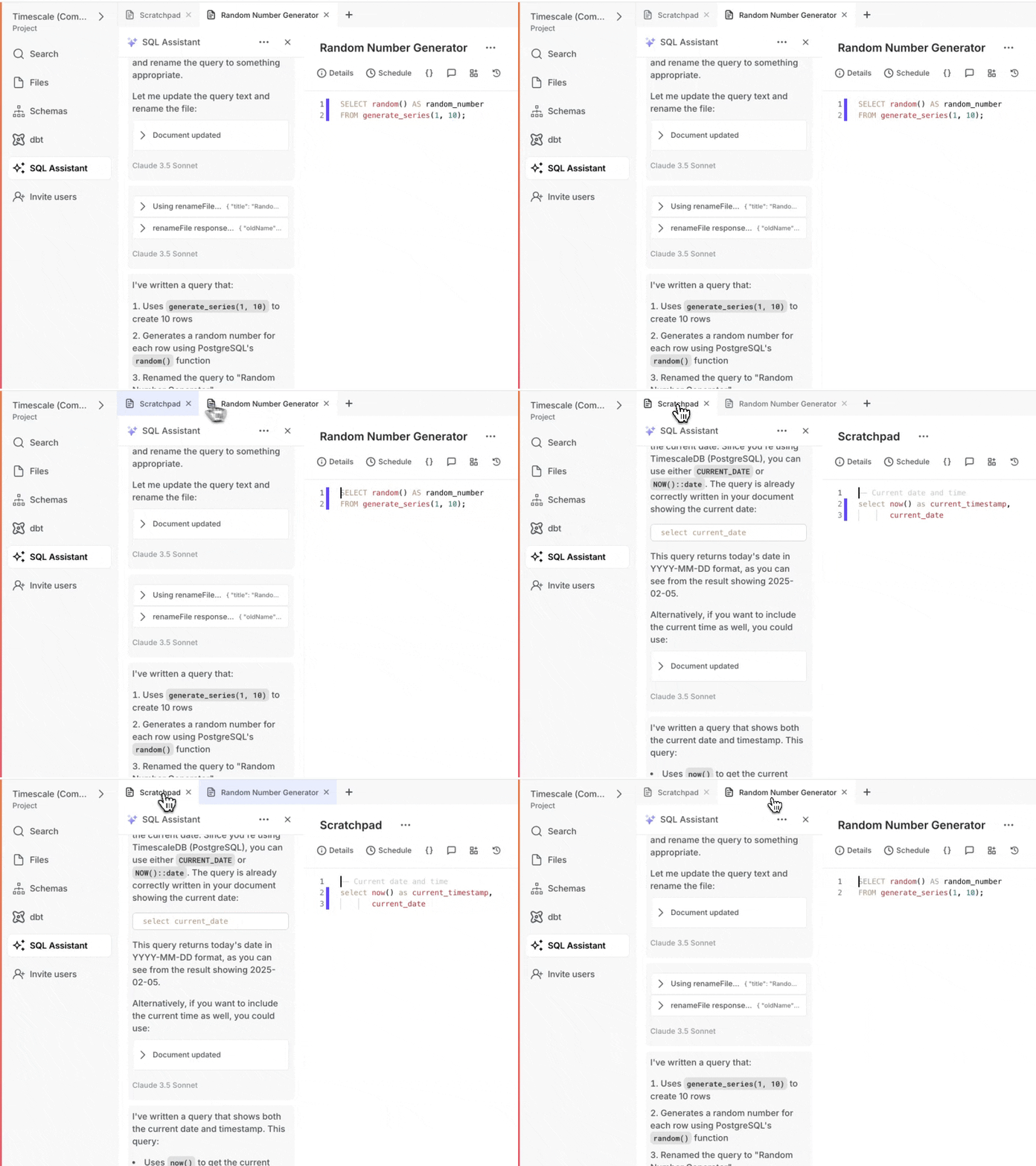
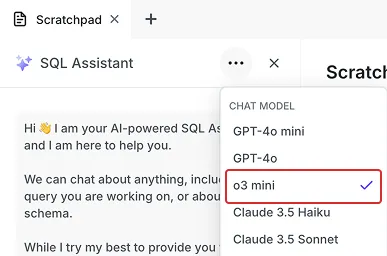
Read replica sets, faster tables, new anthropic models, and VPC support in data mode
Prometheus Exporter for Tiger Cloud enables shipping of TimescaleDB metrics with custom Grafana dashboards and alerting. For configuration details, see metrics to Prometheus.
Support for vectors with up to 16,000 dimensions. NEON support for SIMD distance calculations on aarch64 processors. See the pgvectorscale 0.6.0 release notes for details.
pgai Vectorizer supports models from AWS Bedrock, Azure AI, Google Vertex via LiteLLM
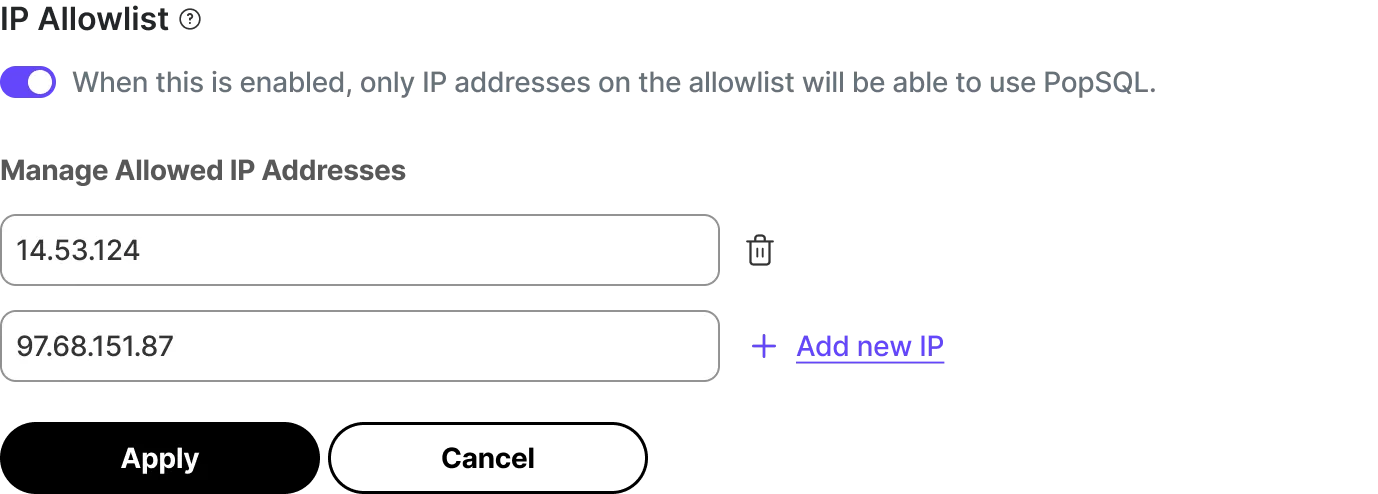
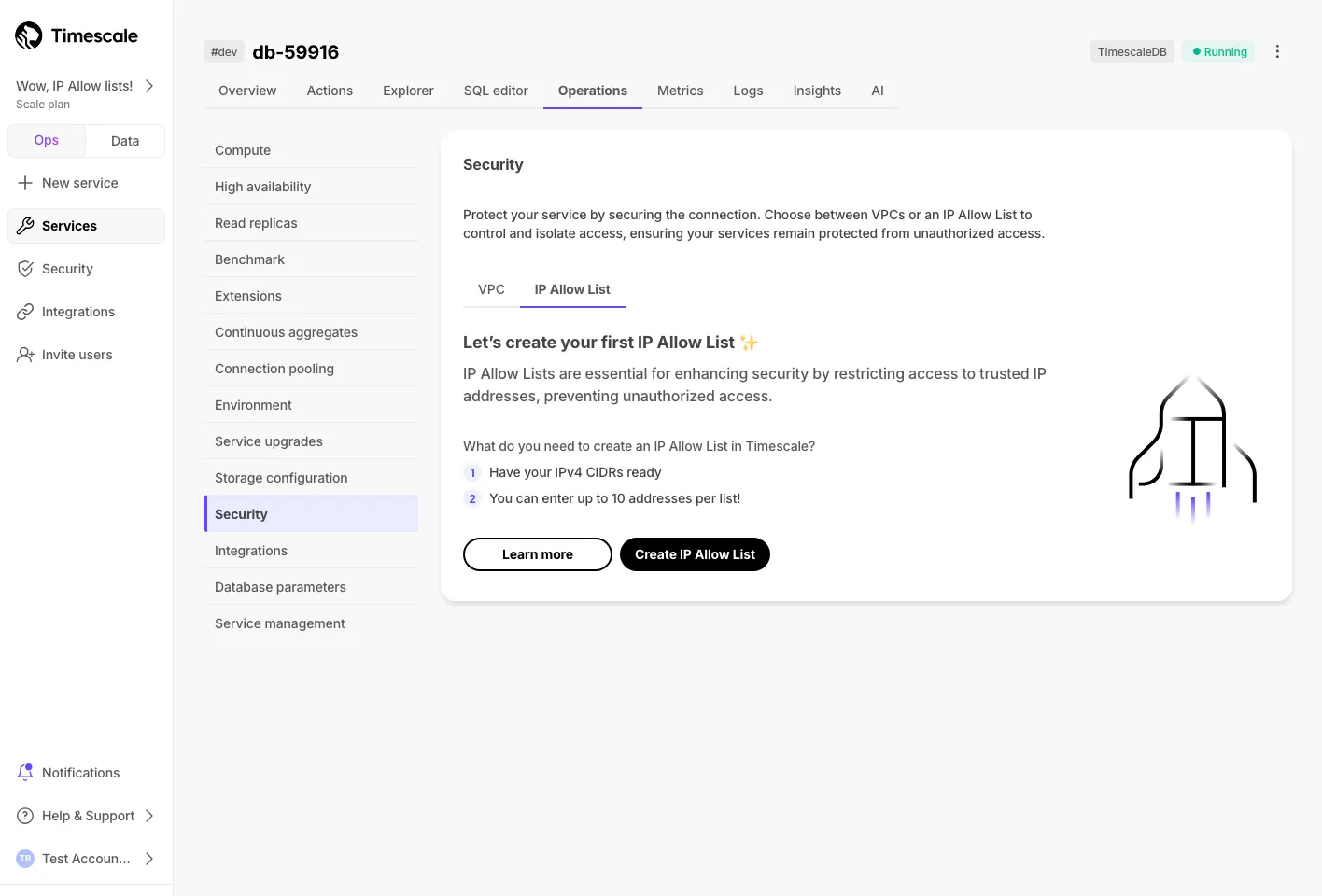
IP allowlists now available in Tiger Console data mode and PopSQL for enhanced network security. For background and configuration examples, see the IP allow list documentation.
Added configurable base_url support for OpenAI API, public granting of vectorizers, and improved Ollama client. See all changes in the pgai extension 0.7.0 release.
IP Allow Lists let you specify IP addresses that have access to services and block others. They provide a lightweight alternative to a full Virtual Private Cloud (VPC).
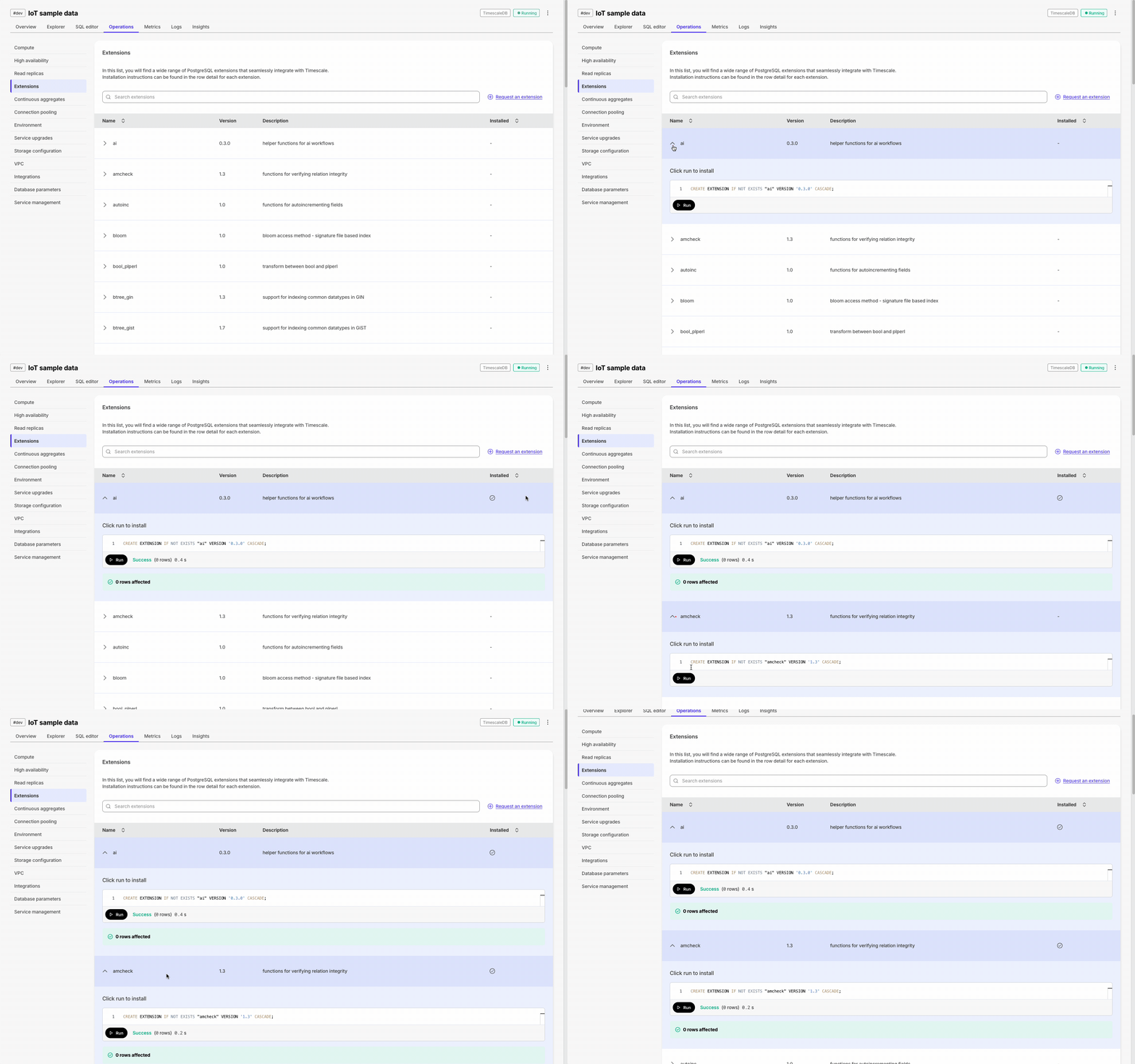
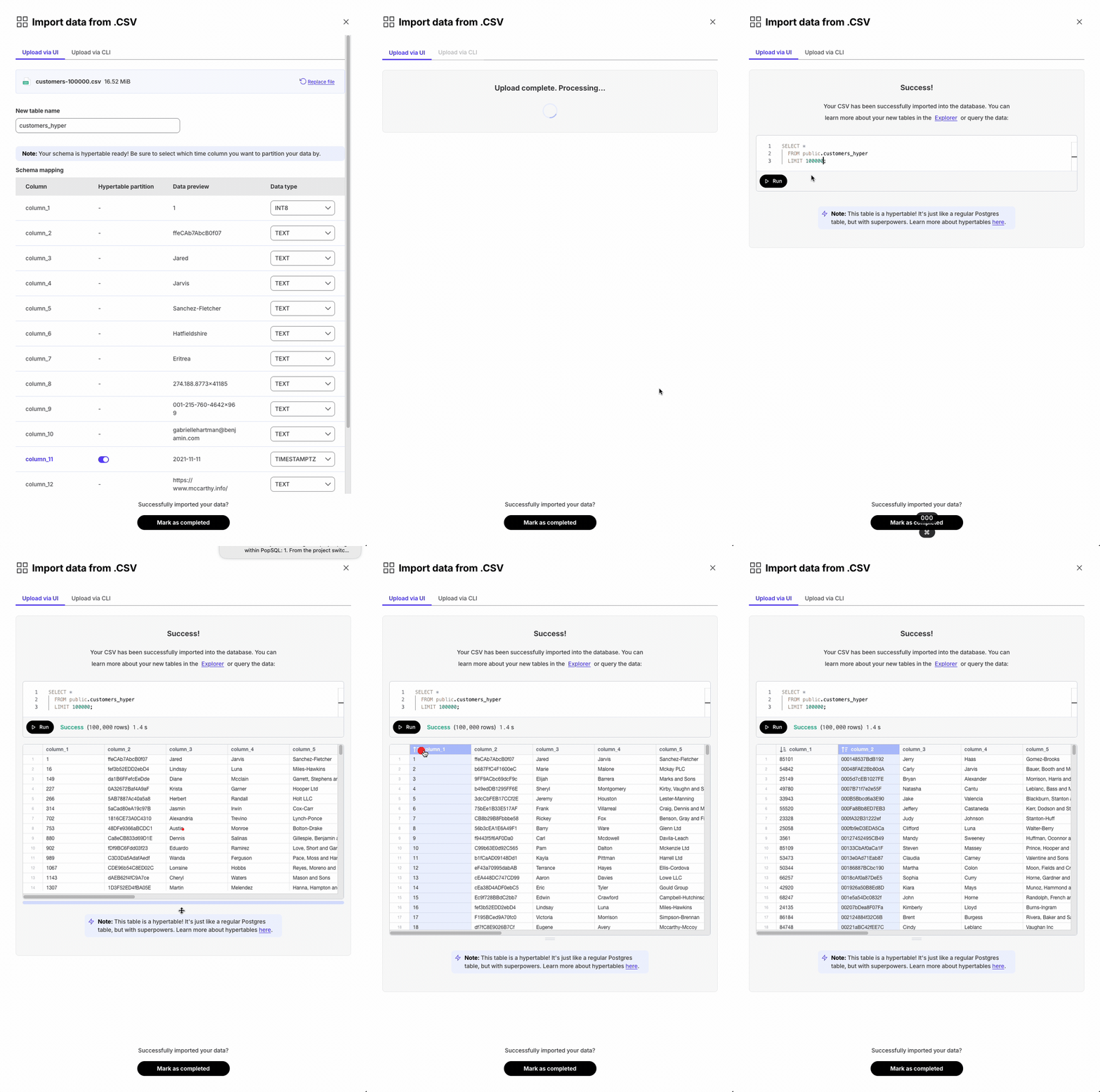
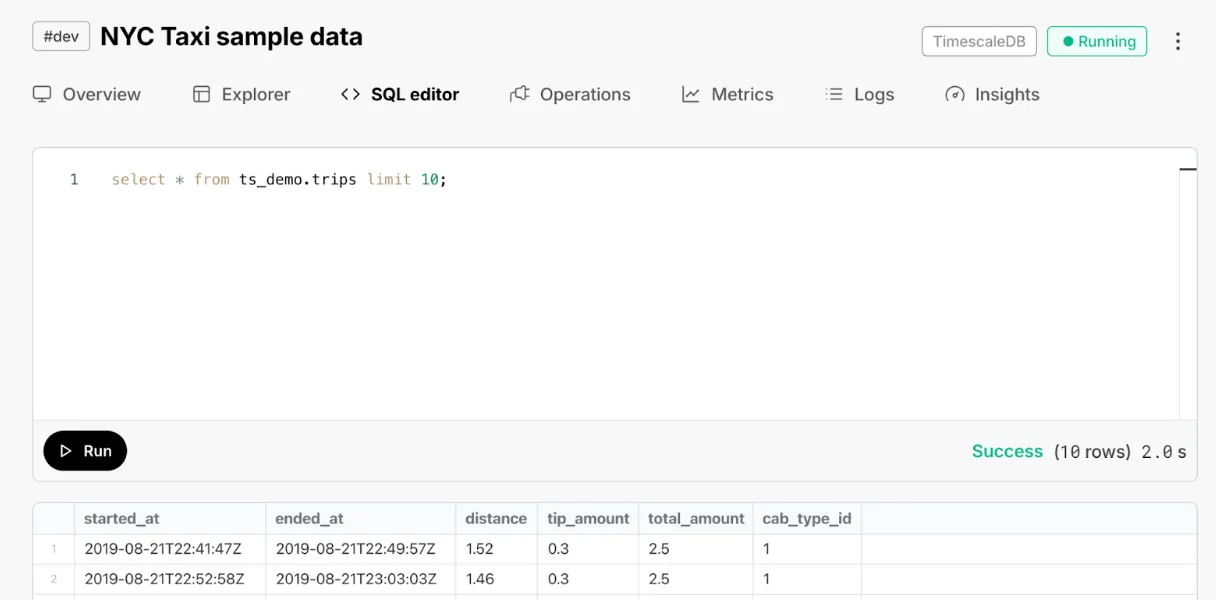
Execute SQL statements with one click throughout Console for hypertables, extensions, and CSV imports. This requires that the SQL editor is enabled for the service.
TimescaleDB v2.15.3 and v2.15.2 patch releases with multiple improvements. For more information, see the 2.15.3 release note and the 2.15.2 release note.
Performance improvements for live migration to Tiger Cloud
The Timescale live-migration Docker image now supports table-based filtering during live migration, improvements to pbcopydb (including better performance and removal of unhelpful warnings), and a user notification log to help you always select the most recent release for a migration run.
Ollama is now integrated with the pgai extension, making it easy to work with open-source language models such as Llama 3, Mistral, Phi 3, and Gemma. Ollama acts like “Docker for LLMs,” providing a simple way to run and manage models locally.
With pgai installed in your database, you can embed Ollama-powered AI directly into your app using SQL, for example, by generating completions or working with images in a single query.
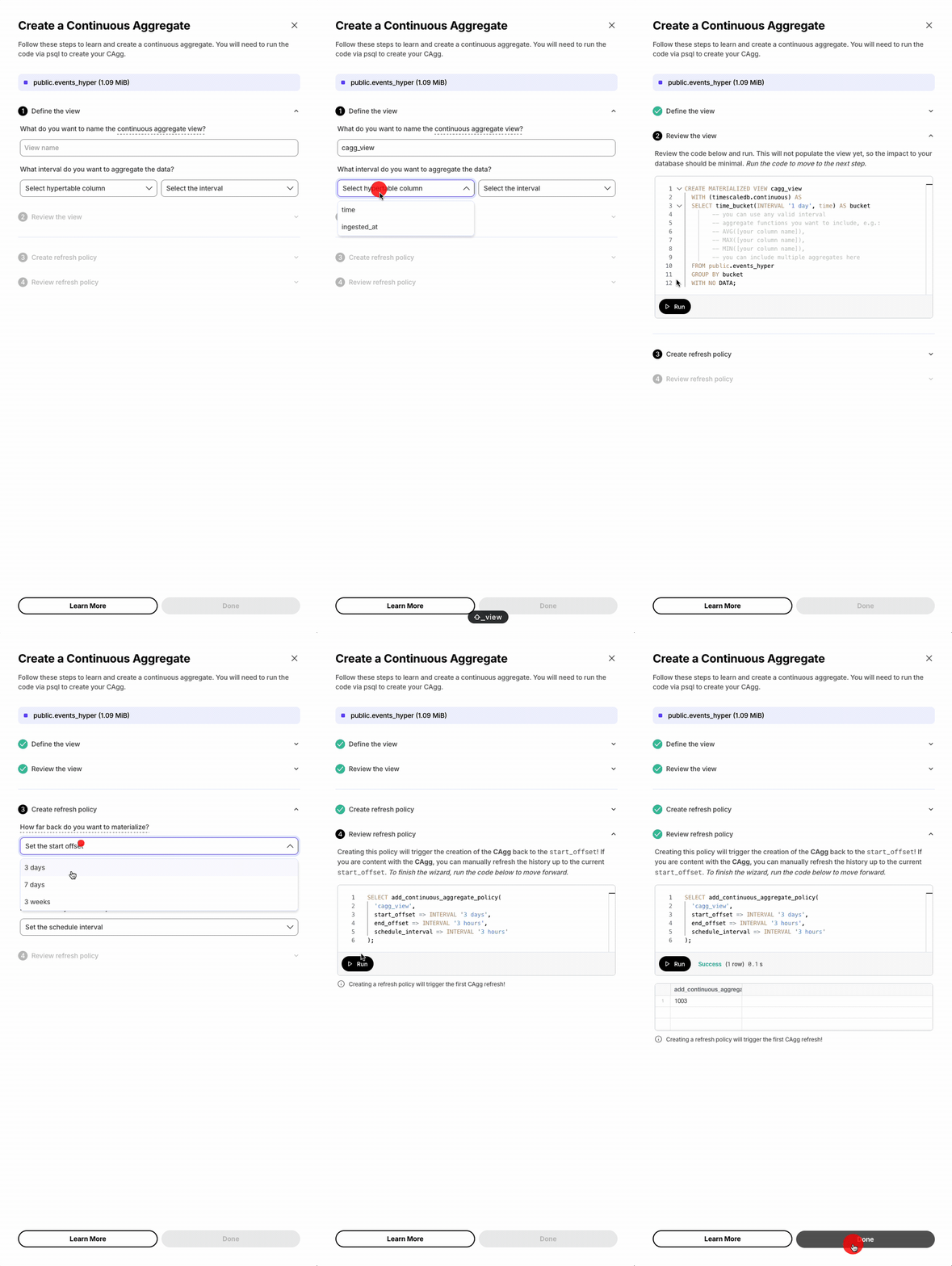
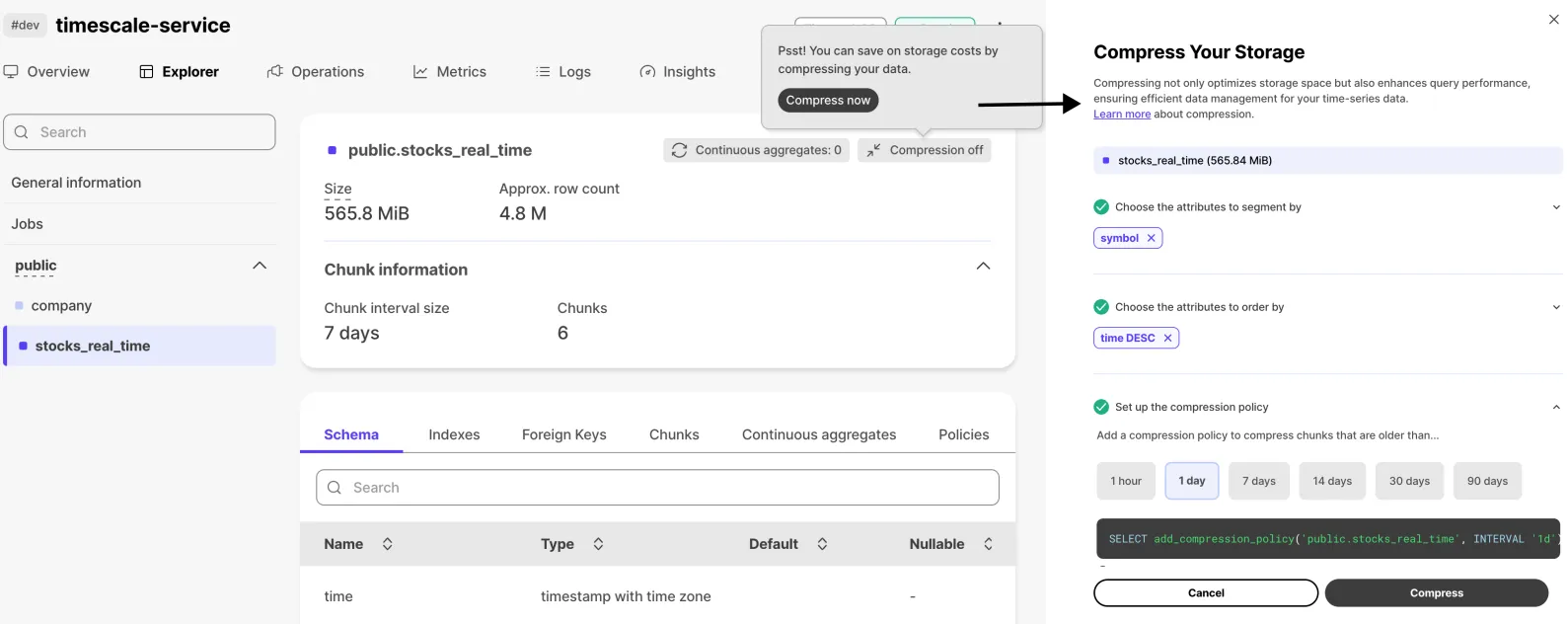
The compression wizard is now available in Timescale Console. From the Explorer, select a hypertable and, in the top-right corner, hover where it says “Compression off” to open the wizard. You’ll be guided through configuring compression for the hypertable and can enable it directly from the UI.
The pgvectorscale extension is now available on Timescale Cloud. It complements pgvector and introduces:
A new index type, StreamingDiskANN, inspired by Microsoft’s DiskANN algorithm.
Statistical Binary Quantization, a compression method developed by Timescale researchers that improves on standard binary quantization.
On a benchmark dataset of 50 million Cohere embeddings (768 dimensions), PostgreSQL with pgvector and pgvectorscale achieves dramatically lower p95 latency and higher query throughput than Pinecone’s storage-optimized index at comparable recall, while running at significantly lower cost on self-hosted AWS EC2.
Continuous Aggregate supports time_bucket with origin and/or offset
Compression improvements with optimized defaults and planner enhancements
These releases also add planner improvements to inspect more WHERE conditions before decompression (reducing the number of rows that must be decompressed), allow minmax sparse indexes to be used when compressing columns with btree indexes, and introduce vectorized filters in WHERE clauses containing text equality operators and LIKE expressions.
PostgreSQL Audit extension (pgaudit) now available on Tiger Cloud for detailed session and object audit logging. See the PG Audit extension (pgaudit) and pgaudit documentation for more information.
International system of unit support with postgresql-unit
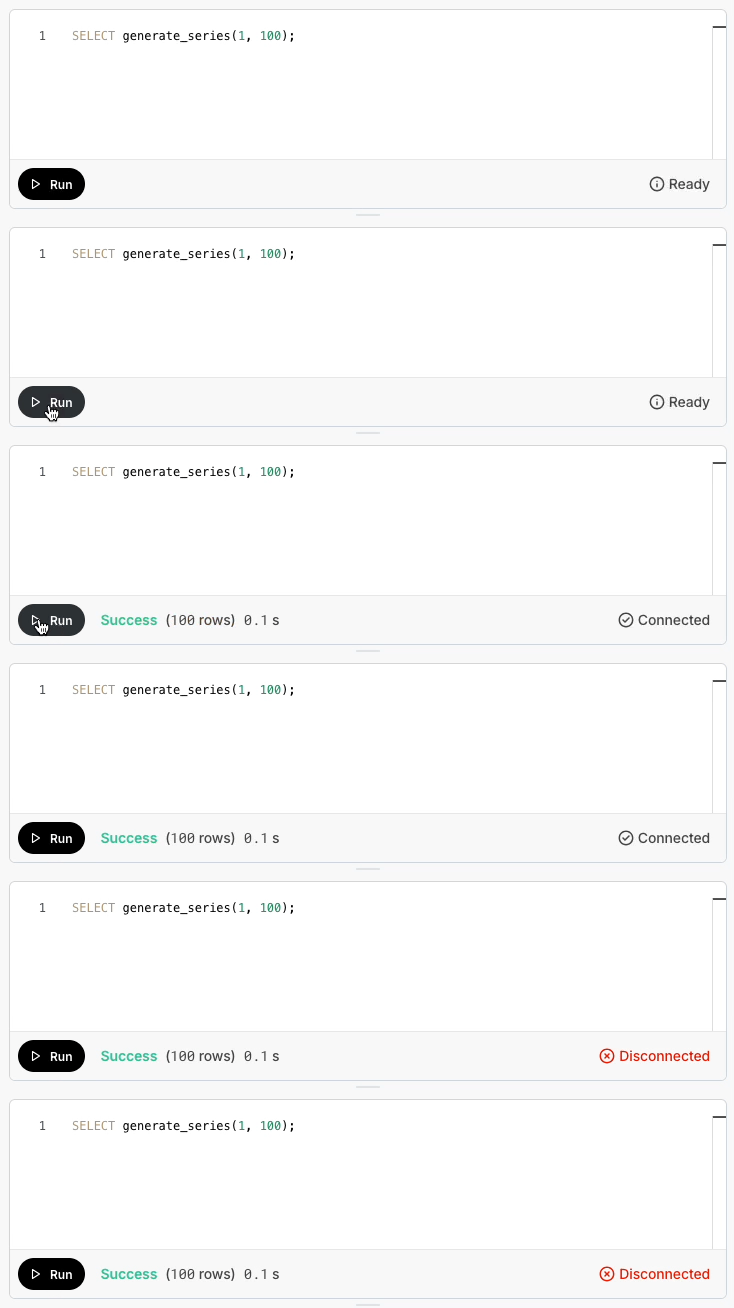
You can use Timescale Cloud to solve day-to-day questions. For example, to see what 50°C is in °F, run the following
query in your Timescale Cloud service: